
Hello, this is Sunyujae Korean Medicine Clinic, a place where kind hearts reside.
![[Child's Height Growth] Part 1: The Story of Growth Herbal Medicine Starting in Winter Break - Sunyujae Korean Medicine Clinic in Dongcheon-dong, Suji-gu](https://syjkmc.kr/wp-content/uploads/2026/06/224122589415_img_0.png)

Winter break is a really good time to start growth management
As winter break approaches, we often hear similar questions: “Is now a good time to start growth management?” “What can I do during the break to help my child grow?” Winter break is indeed an excellent time to begin growth management. This is because growth isn’t about a child suddenly shooting up in height one day; rather, it’s a process where the child’s body must first be prepared with the right environment for growth, and only then will the results follow.
During the school semester, sleep and meal times can easily become irregular, and accumulated fatigue from studies and activities can make it difficult for a child’s body to focus on growth. Winter break, on the other hand, is a time to reorganize a child’s daily rhythm and check their physical condition. That’s why, during growth consultations, I emphasize that winter break is not a time to rush growth, but rather a time to prepare the body for optimal growth.
Winter: A Time for Consistent Management
During the school semester, both children and mothers are busy with schoolwork, academies, and various activities. This makes it difficult to consistently manage medication times, sleep schedules, and meal rhythms. During the break, however, daily routines can be made relatively simpler, making medication and lifestyle management much easier.
In growth management, “how consistently it is maintained” is more important than “what is done,” and this makes a surprisingly big difference. Winter is crucial for managing basic physical strength. During winter, colds and minor illnesses become more frequent, and reduced activity levels can easily lead to a drop in physical stamina.
When physical strength declines, energy that should be used for growth is often diverted to recovery and defense. By nourishing the body and building up immunity and basic physical strength during this period, it helps reduce minor colds and illnesses and creates a stable environment for growth to occur.
Winter break also serves as a time to prepare for the new semester
If a child’s body balance and condition are well-managed during the break, they can start the new semester in a much more stable state after school resumes.
There is a clear difference in a child’s growth trajectory between starting a year with accumulated fatigue and starting a year with a well-regulated body. Growth is not solely a matter of genetics. One of the most common things parents say during growth consultations is:
“Our family is genetically short, so…” “…there’s nothing we can do.” However, a synthesis of current medical research on pediatric growth often reports that genetics account for approximately 20-30% of a child’s height. The remaining 70% or more is influenced by acquired factors, meaning lifestyle and management elements such as nutritional status, quality and duration of sleep, physical activity levels, overall health, and history of illnesses during the growth period all play a role.
Indeed, twin studies and family studies repeatedly report that even with identical genetic conditions, differences in final height can occur depending on dietary habits, sleep quality, activity levels, and health status during the growth period.
What Twin Growth Studies Tell Us
To understand the distinct influences of genetics and environment on a child’s height growth, twin (zygosity) growth studies are the most frequently utilized medical research.
A representative study is “Heritability of adult body height” (American Journal of Human Biology, 2003) published by Silventoinen K. et al.
This study analyzed twin cohorts from various countries This is a large-scale study that analyzed twin cohorts from various countries to compare the genetic and environmental influences on adult height. The study reported that the heritability of height is approximately 60-80%, but it also confirmed that even among twins with identical genetic conditions, differences in final height can emerge due to variations in nutritional status, illness history, and living environment during the growth period.
In other words, genetics only suggest the potential range within which a child can grow, and how much they actually grow within that range can vary depending on management and environmental factors during the growth process. These research findings medically support the idea that a child’s current height is not a predetermined outcome, but rather a process that can be influenced by how they are managed during their growth period.
Medically, height is known to be a polygenic trait, meaning it is not determined by a single gene but involves multiple genes related to growth hormone secretion, growth plate response, bone metabolism, and nutrient absorption. Therefore, parental height is just one factor influencing a child’s growth, not a value that precisely fixes a child’s final height.
Genetics are more akin to setting a possible range within which a child can grow, and how much they actually grow within that range can vary depending on their living environment and management during the growth process.

The Goal of Growth Treatment is Not a ‘Number’ Growth treatment does not simply aim to add a few centimeters to a child’s height. From a medical perspective, growth occurs most stably when growth hormone secretion, nutrient absorption, recovery during sleep, immunity, and metabolic state are in harmony. In other words, the original purpose of growth treatment is to create a physical condition where the child can eat well, sleep deeply, and recover effectively, thereby allowing growth to proceed naturally.
Therefore, when managing growth, we don’t just look at the outcome of height. Instead, the process of checking the child’s food intake and digestion, sleep duration and quality, activity level, overall health, and boosting immunity must precede. When these basic conditions are met, the function of the growth plates and the action of growth hormones can also occur most efficiently.
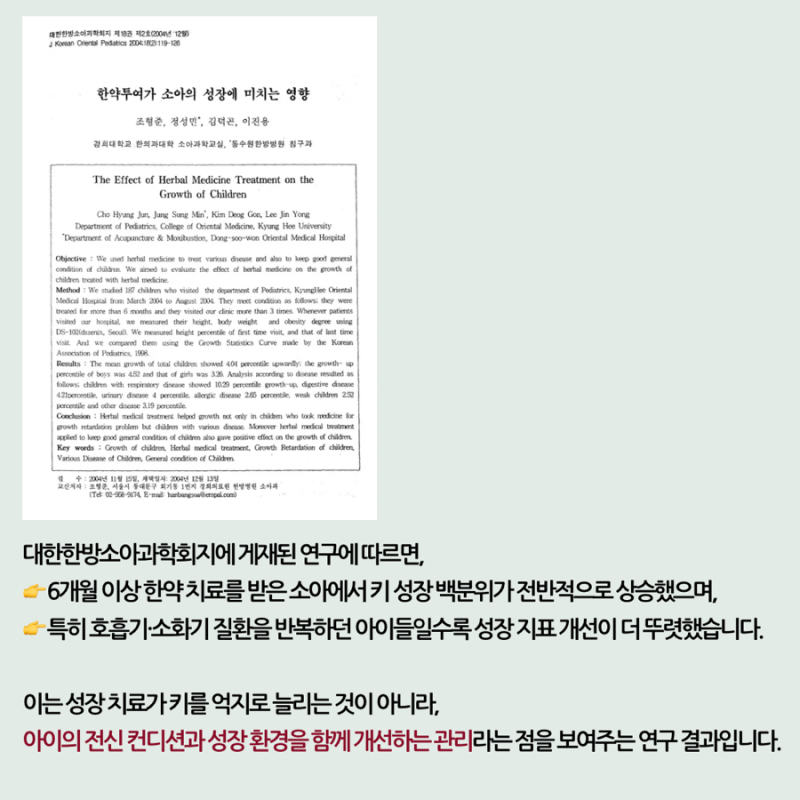
The timing of growth treatment can be missed if you hesitate. Many parents often place all their hopes on pubertal growth spurts, but in reality, the pubertal growth spurt accounts for only a portion (approximately 15% of total growth) of overall height growth. Therefore, for growth treatment, the question “When should we start?” is less important than “How should we manage my child’s current physical condition?”
Winter break is not a time to rush a child’s height growth, but rather a time to prepare the body for optimal growth. Taking this break as an opportunity to review your child’s constitution, lifestyle habits, and growth environment can be a meaningful choice in their long growth journey.
In the next post 👉 we will explain important aspects of child growth, including growth spurts and growth periods, and for which children growth herbal medicine is necessary. https://m.blog.naver.com/sunyujae21/224122510030 We hope you will continue to join Sunyujae Korean Medicine Clinic as we share valuable information for a healthy life. Sunyujae Korean Medicine Clinic in Suji-gu pursues evidence-based medicine and integrative medicine.

This post was written directly by the medical staff of Sunyujae Korean Medicine Clinic to provide medical information, in compliance with Article 56(2) and Article 57(3) of the Medical Service Act. The duration and outcome of treatment may vary from person to person, so please consult a qualified practitioner before beginning treatment.
Consultation & Booking
Have questions? Reach us anytime via KakaoTalk or phone.