
Sunyujae Specialized Treatment
Acupotomy Treatment
There are pains that improve during treatment but return to the same uncomfortable spot over time. Acupotomy is a treatment that releases tissues adhered around nerves, restoring an environment where nerves can move naturally again. Sunyujae Korean Medicine Clinic performs acupotomy based on anatomical evaluation and palpation, actively utilizing ultrasound for areas that require confirmation.
When Acupotomy May Be Considered
Not all cases listed below are candidates for acupotomy treatment. The decision is made after examination and movement evaluation, and if necessary, confirmed with ultrasound.
What Is Acupotomy?
Acupotomy (鍼刀) is a treatment that uses a tool with a fine blade-like tip (刀) to release adhered or scarred soft tissue. It is a minimally invasive treatment, different from incisional surgery, and aims to minimize unnecessary damage while accessing only the target area.
The treatment has three goals: carefully releasing tissues adhered around nerves, restoring the movement of tissues restricted by adhesion, and regaining an environment where nerves and surrounding tissues can move naturally again.
| Treatment | Approach | Primarily performed in these cases |
|---|---|---|
| Acupuncture | Regulation through stimulation | When pain control and functional recovery are needed |
| Pharmacopuncture | Chemical approach | When inflammation control and tissue recovery are needed |
| Acupotomy | Mechanical approach | When tissue movement is restricted by adhesion or scar tissue |
These three treatments are not in competition but act on different levels, so they are used complementarily depending on the patient’s condition.
Why Does the Same Pain Recur?
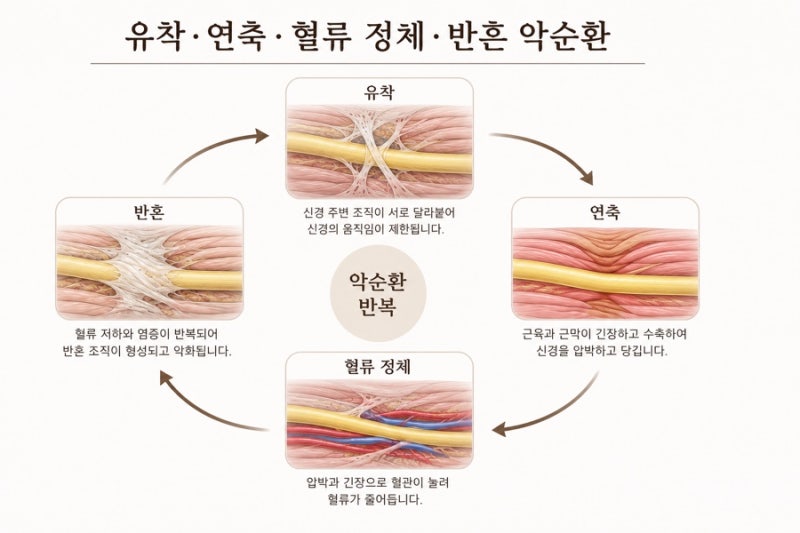
The vicious cycle of nerve adhesion, spasm, blood flow stagnation, and scar tissue
Nerves are not fixed structures like electrical wires. When you turn your neck, bend your waist, or move your wrist, nerves also glide between muscles, fascia, and ligaments, distributing tension. This movement is called Nerve Gliding.
When adhesion forms in the tissues around nerves due to repeated use, trauma, inflammation, or post-surgical changes, this gliding is restricted. This increases friction and tension with every movement, reduces blood flow, slows recovery, and leaves hardened tissue as scar tissue, further exacerbating adhesion. As this cycle repeats, pain becomes more likely to become chronic.
Ultrasound Confirmation When Needed
Anatomical knowledge and palpation are fundamental; ultrasound is used for areas requiring confirmation.
Acupotomy treatment is fundamentally performed based on anatomical knowledge, palpation, and clinical experience. However, in areas where nerves or blood vessels pass nearby or where visual confirmation of structures is necessary, we proceed by directly confirming with ultrasound before, during, and after treatment.
Target
First, we identify the tissues to be treated.
No-go
We identify vascular and neural structures to avoid.
Safe Plane
We plan a safe access path in advance.
Tip Tracking
We confirm the position of the acupotomy tip in real-time.
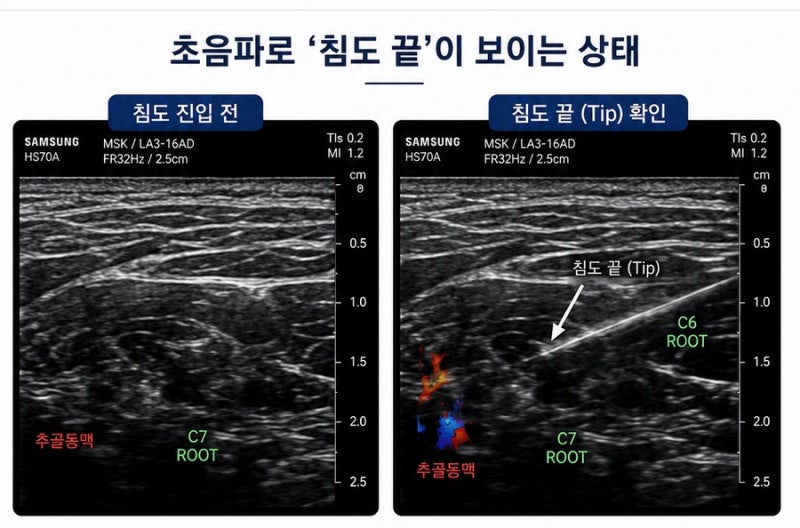
The reason we use ultrasound when necessary is to access only the target tissue while protecting the surrounding healthy tissues.
Conditions We Treat
Click each item to go to a detailed article about the corresponding condition.
Trigger FingerWhen a finger catches with a ‘click’ and is difficult to straighten.Golfer’s ElbowWhen pain on the inner elbow recurs even with rest.Frozen ShoulderWhen the arm cannot be raised and the shoulder hurts at night.Carpal Tunnel SyndromeWhen hand numbness and wrist pain persist.Spinal StenosisWhen walking is difficult and legs feel numb.Neck and Shoulder StiffnessRecurring stiffness due to myofascial pain syndrome.Cervicogenic HeadacheHeadaches originating from the neck and occipital neuralgia.Plantar FasciitisWhen the heel hurts with the first step in the morning.
In addition Post-cerebrovascular disease management, Recurring chronic painmay also be considered for application depending on the condition.
How Ultrasound-Guided Acupotomy Is Performed
- Examination and Movement EvaluationWe examine not only the painful spot but also the entire path of the nerve and the muscles, fascia, and ligaments that form that path.
- Ultrasound ConfirmationWe identify the tissues to be treated and structures to avoid, then plan the access path.
- Acupotomy TreatmentWe precisely access the planned area to release adhered tissues. Acupuncture and pharmacopuncture may be combined as needed.
- Progress Check and Lifestyle ManagementWe confirm changes after treatment and provide guidance on lifestyle management to reduce recurrence.
What Makes Sunyujae’s Acupotomy Different
Acupotomy is a treatment that requires anatomical knowledge and specialized training. Therefore, we also engage in research and academic activities outside of the clinic.
- Overall Planning for Korean Acupotomy Medicine Society Academic ConferencesDirector Hyocheong Chae is in charge of planning the society’s academic conferences. Details
- Korean Acupotomy Medicine Society Journal Listed in KCIParticipating as a planning director for the society’s journal. Details
- ICMART International Conference PresentationAcupotomy research was presented at the French conference in 2025, following 2024. Details
- Lectures at Korean Medical UniversitiesProviding lectures on meridianology and practical training guidance at Dongguk University and Daejeon University Colleges of Korean Medicine. Details
- Research Collaboration with Dongguk University College of Korean MedicineExpanding research foundations through an MOU with the Korean Acupotomy Medicine Society. Details
- Both directors share the same techniques.Both directors are members of the Korean Acupotomy Medicine Society and share the same acupotomy techniques and treatment philosophy.
Frequently Asked Questions
Is acupotomy a surgical procedure?
No. Acupotomy is a minimally invasive treatment, different from incisional surgery. Its applicability varies depending on the condition and state of the disease.
What kind of pain is it applied to?
It is considered for musculoskeletal pain when adhesion or scar tissue around nerve tissue is identified as the cause of pain. It is not a treatment applicable to all types of pain; the decision is made after examination, and if necessary, confirmed with ultrasound.
Can nerve adhesion be confirmed with ultrasound?
Ultrasound is used to evaluate the nerve’s location, surrounding tissue condition, and movement, which helps in formulating a treatment plan.
Is it very painful?
The sensation may vary depending on the treatment area and the degree of adhesion.
How many sessions are typically needed?
This depends on the degree and duration of the adhesion. Mild adhesion may show changes with as few as 1-3 sessions, while long-standing adhesion often requires multiple sessions.
Should acupotomy and pharmacopuncture be received together?
They may be considered together depending on the patient’s condition. If adhesion is the primary concern, acupotomy may be prioritized; if inflammation control is more needed, pharmacopuncture may be prioritized.
Learn More
What is Acupotomy Treatment? Why Does Pain Recur?
The Principle of Acupotomy Treatment Understood Through Nerve Adhesion and Nerve Gliding
Effects, Applicable Conditions, and Process of Acupotomy Treatment
Why Sunyujae Korean Medicine Clinic Chose Acupotomy Treatment and Our Treatment Philosophy
This post was written directly by the medical staff of Sunyujae Korean Medicine Clinic to provide medical information, in compliance with Article 56(2) and Article 57(3) of the Medical Service Act. The duration and outcome of treatment may vary from person to person, so please consult a qualified practitioner before beginning treatment.
Consultation & Booking
Have questions? Reach us anytime via KakaoTalk or phone.