Hello, I am Dr. Hyocheong Chae, the director of Sunyujae Korean Medicine Clinic in Dongcheon-dong, a place where kind hearts reside.
Herbal medicine is made from natural ingredients and helps support the body’s natural healing power. Since herbal medicine supplements what is lacking in each individual’s constitution, it is most important to take it according to your own constitution. A Korean medicine doctor systematically diagnoses the body’s condition, constitution, etc., and based on the results, identifies the cause of discomfort and physiological characteristics to provide a customized prescription.
Therefore, it is essential to take herbal medicine that suits your body’s condition under the diagnosis of a Korean medicine doctor. There is a lot of misinformation about herbal medicine. Let’s talk about the misunderstandings and truths about herbal medicine.
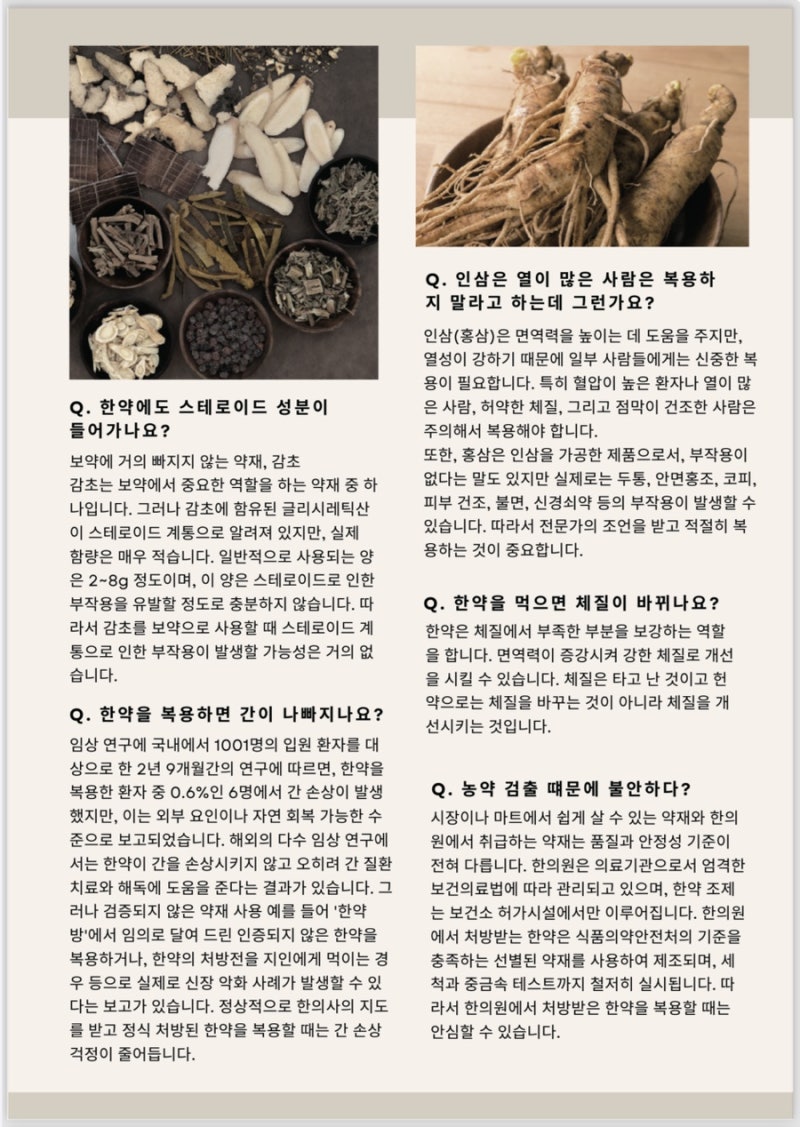
Does taking herbal medicine make you gain weight? Taking herbal medicine does not necessarily lead to weight gain. The calorie content of herbal medicine is approximately 20kcal per 100ml.
Herbal medicine itself does not cause weight gain. In cases of weak digestion, herbal ingredients that enhance digestive function can be used to improve nutrient absorption and increase body weight. Conversely, individuals with poor blood circulation and cold bodies that cause swelling can improve blood circulation and warm the body through prescriptions, thereby reducing swelling, increasing activity, and losing weight.
Depending on an individual’s constitution and body condition, herbal medicine may be prescribed to promote weight gain or weight loss. It is important to take herbal medicine tailored to your individual constitution through a customized prescription from a Korean medicine doctor. Does taking herbal medicine change your constitution?
Herbal medicine plays a role in supplementing what is lacking in one’s constitution. It can strengthen immunity and improve the constitution to a more robust one. Constitution is innate; herbal medicine does not change the constitution but rather improves it.
Does herbal medicine contain steroids? Licorice, an herb almost always included in tonics. Licorice is one of the important herbs in tonics. However, while glycyrrhetinic acid contained in licorice is known to be a steroid compound, its actual content is very low. The amount typically used is about 2-8g, which is not enough to cause steroid-related side effects.
Therefore, when licorice is used in tonics, the likelihood of steroid-related side effects occurring is very low. Does taking herbal medicine harm the liver? According to clinical research, in a study conducted in Korea over 2 years and 9 months involving 1001 hospitalized patients, liver damage occurred in 6 patients (0.6%) who took herbal medicine, but this was reported to be due to external factors or at a level capable of natural recovery.
Numerous overseas clinical studies have shown that herbal medicine does not damage the liver; instead, it helps treat liver diseases and aids in detoxification. However, there are reports that actual cases of kidney deterioration can occur due to the use of unverified medicinal ingredients, for example, taking uncertified herbal medicine arbitrarily decocted at a ‘traditional herbal pharmacy’ or giving an herbal medicine prescription to an acquaintance.
When taking officially prescribed herbal medicine under the guidance of a Korean medicine doctor, concerns about liver damage are reduced. In a study conducted over 2 years and 9 months involving 1001 hospitalized patients, liver damage was confirmed in 6 patients (0.6%) who took herbal medicine. The liver damage in these 6 individuals was reported to be due to external factors rather than the herbal medicine itself, or at a level capable of natural recovery. Furthermore, numerous overseas clinical papers also state that herbal medicine does not damage the liver; instead, it has the effect of treating liver diseases and aiding in liver detoxification.
Can we be assured about pesticide detection? The medicinal ingredients readily available in markets or supermarkets differ in quality and safety standards from those handled at Korean medicine clinics. As medical institutions, Korean medicine clinics are managed under strict public health and medical laws, and herbal medicine preparation is carried out only in facilities approved by public health centers.
Herbal medicine prescribed at a Korean medicine clinic is manufactured using selected medicinal ingredients that meet the standards of the Ministry of Food and Drug Safety, and undergoes washing and heavy metal testing. Therefore, you can feel safe taking herbal medicine prescribed at a Korean medicine clinic. It is said that people with a lot of internal heat should not take ginseng. Is that true?
Ginseng (red ginseng) helps boost immunity, but due to its strong warming properties, some individuals need to take it cautiously. Especially patients with high blood pressure, those with a lot of internal heat, those with a weak constitution, and those with dry mucous membranes should take it with caution. Furthermore, red ginseng is a processed product of ginseng, and while it is sometimes said to have no side effects, it can actually cause side effects such as headaches, facial flushing, nosebleeds, dry skin, insomnia, and neurasthenia. Therefore, it is important to seek expert advice and take it appropriately.
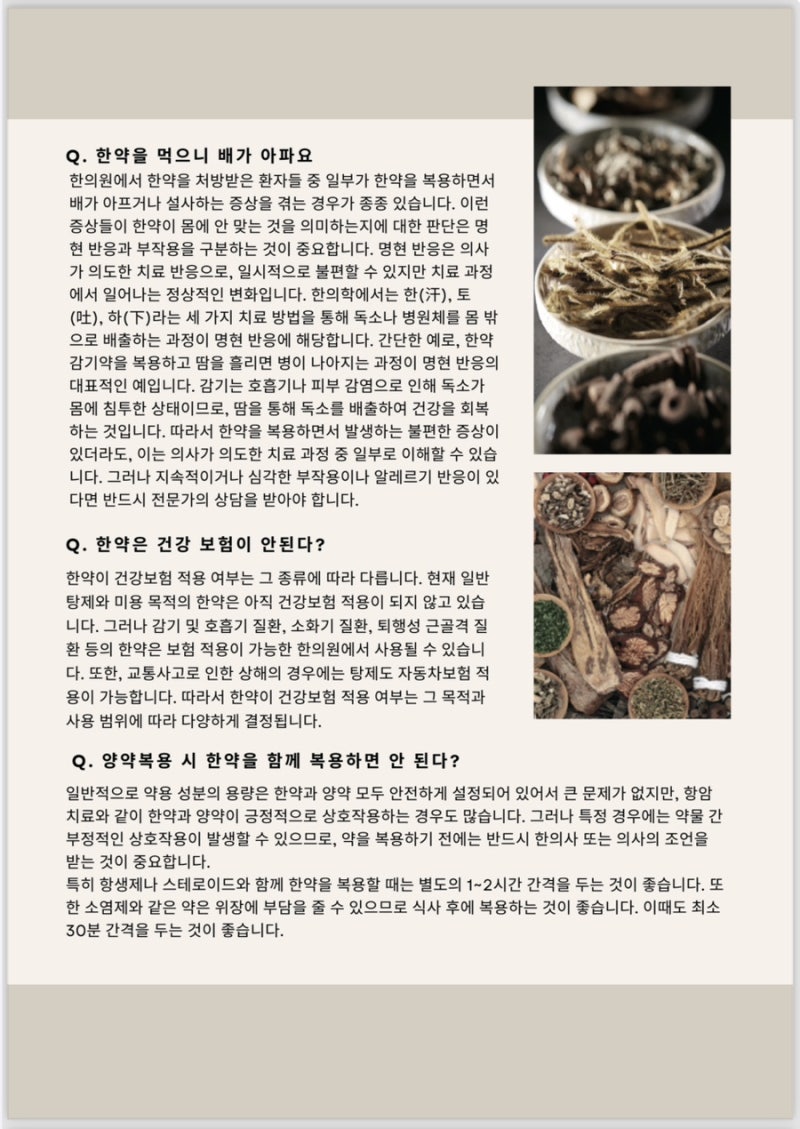
Should I not take herbal medicine together with Western medicine? Generally, the dosages of medicinal ingredients for both herbal medicine and Western medicine are safely set, so there are no major problems, and there are many cases where herbal medicine and Western medicine interact positively, such as during cancer treatment. However, in certain cases, negative drug interactions can occur, so it is crucial to seek advice from a Korean medicine doctor or a medical doctor before taking any medication.
Especially when taking herbal medicine with antibiotics or steroids, it is advisable to maintain a separate interval of 1-2 hours. Additionally, medications like anti-inflammatory drugs can put a strain on the stomach, so it is best to take them after meals. In this case, it is also recommended to maintain at least a 30-minute interval.
My stomach hurts after taking herbal medicine. Why is that? Some patients who receive herbal medicine prescriptions from a Korean medicine clinic occasionally experience stomach pain or diarrhea while taking the medicine. To determine if these symptoms mean the herbal medicine is not suitable for your body, it is important to distinguish between a healing crisis and side effects.
A healing crisis is a therapeutic response intended by the doctor, which may cause temporary discomfort but is a normal change occurring during the treatment process. In Korean medicine, the process of expelling toxins or pathogens from the body through three treatment methods—sweating (汗), vomiting (吐), and purging (下)—is considered a healing crisis. A simple example is when you take herbal cold medicine and sweat, the process of recovery from illness is a typical example of a healing crisis. A cold is a condition where toxins have entered the body due to respiratory or skin infection, so expelling toxins through sweat helps restore health.
Therefore, even if you experience uncomfortable symptoms while taking herbal medicine, these can be understood as part of the treatment process intended by the doctor. However, if you experience persistent or severe side effects or allergic reactions, you must consult a specialist. Is herbal medicine not covered by health insurance?
Whether herbal medicine is covered by health insurance depends on its type. Currently, general decoctions and herbal medicine for cosmetic purposes are not yet covered by health insurance. However, herbal medicine for conditions such as colds and respiratory diseases, digestive disorders, and degenerative musculoskeletal diseases can be used at Korean medicine clinics where insurance coverage is available. Furthermore, in cases of injuries due to traffic accidents, decoctions can also be covered by car insurance.
Therefore, whether herbal medicine is covered by health insurance is determined variously depending on its purpose and scope of use.
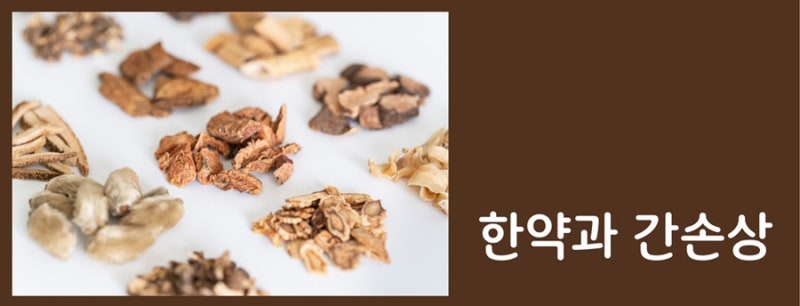
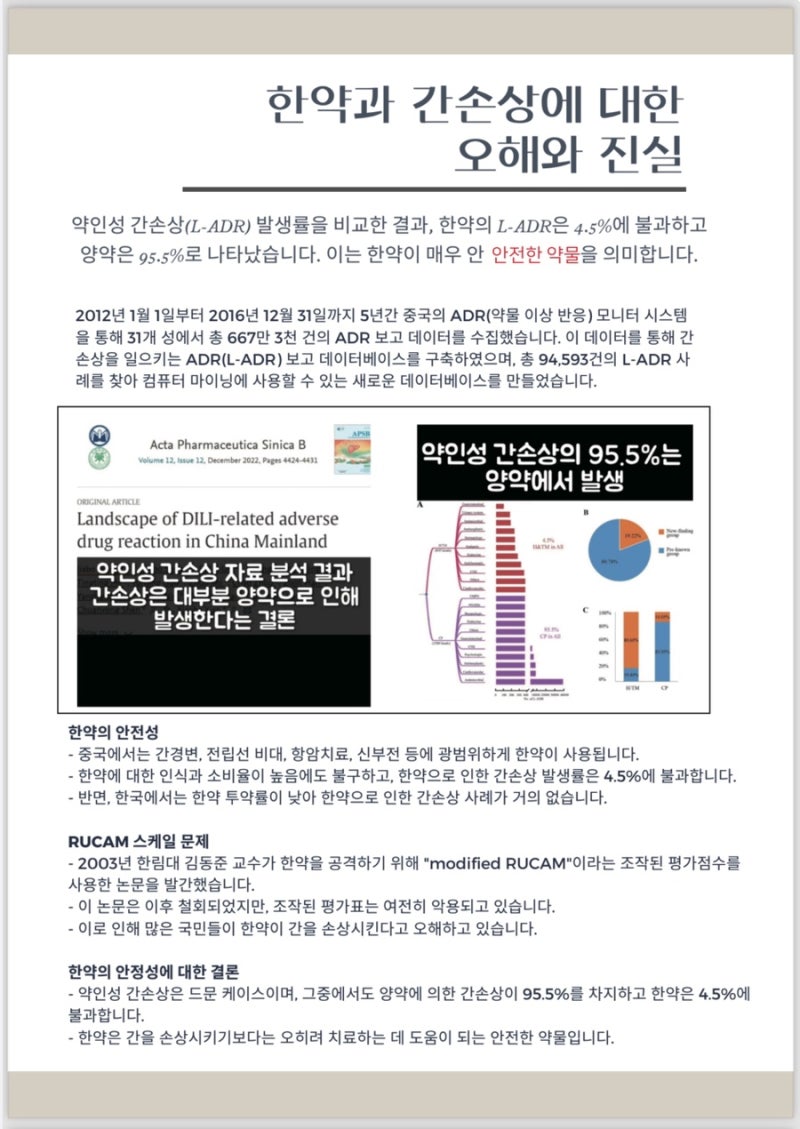
Let’s look at a paper on the misunderstandings and truths about herbal medicine and liver damage. “Analysis of drug-induced liver injury data concludes that most liver damage is caused by Western medicine.”
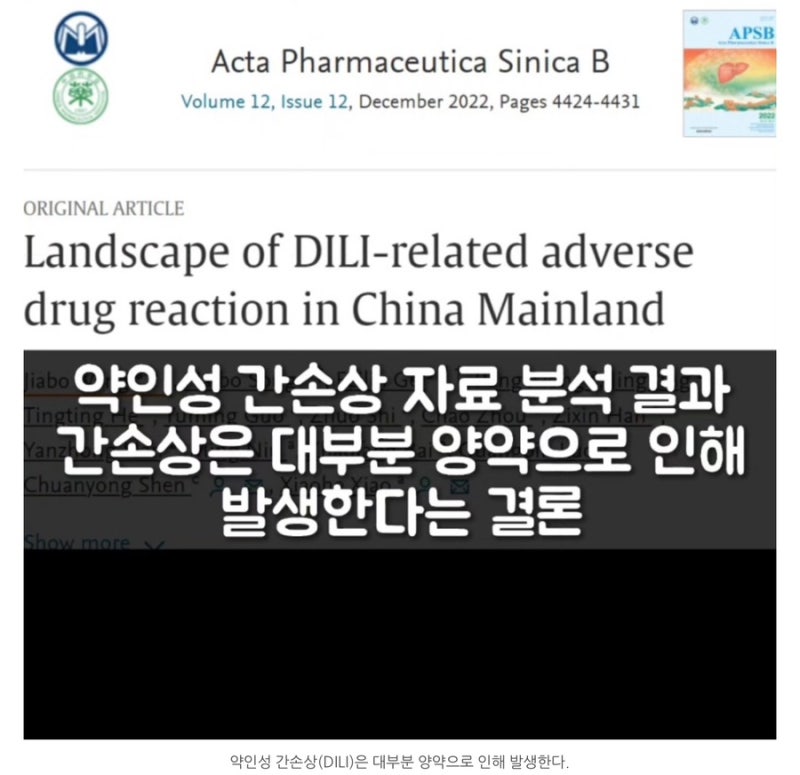
Research results on drug-induced liver injury: From January 1, 2012, to December 31, 2016, over a period of 5 years, a total of 6.673 million ADR (Adverse Drug Reaction) reports were collected from 31 provinces through China’s ADR monitoring system. Using this data, a database of ADR (L-ADR) reports causing liver damage was built, and a new database containing a total of 94,593 L-ADR cases suitable for computer mining was created.
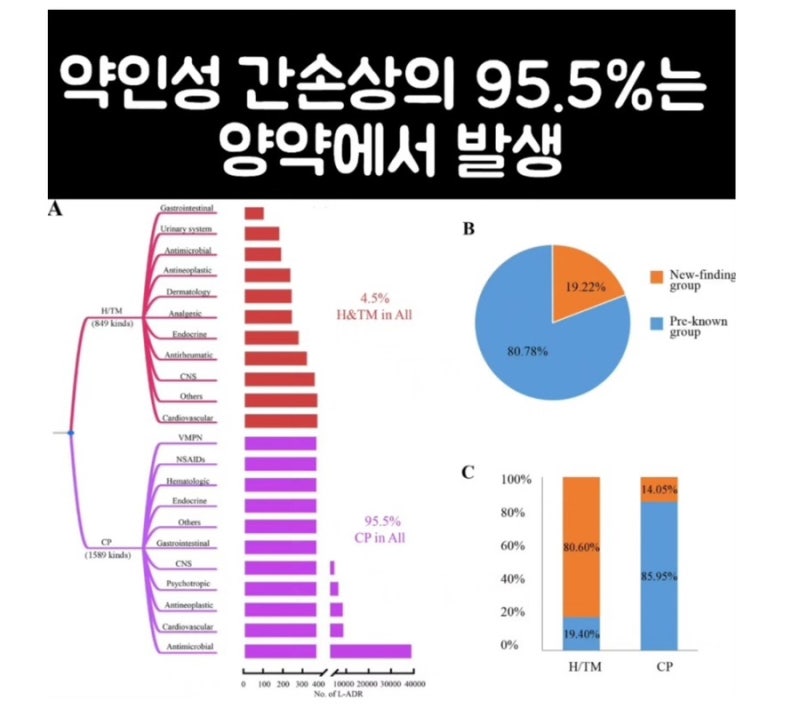
Comparing the incidence of drug-induced liver injury (L-ADR), it was found that L-ADR from herbal medicine accounted for only 4.5%, while Western medicine accounted for 95.5%. This confirms that herbal medicine is a very safe medication. Safety of herbal medicine – In China, herbal medicine is widely used for conditions such as liver cirrhosis, benign prostatic hyperplasia, cancer treatment, and renal failure.
– Despite high awareness and consumption rates of herbal medicine, the incidence of liver damage caused by herbal medicine is only 4.5%. – In contrast, in Korea, the rate of herbal medicine administration is low, resulting in very few cases of liver damage caused by herbal medicine. RUCAM Scale Issue – In 2003, Professor Kim Dong-jun of Hallym University published a paper using a manipulated evaluation score called “modified RUCAM” to attack herbal medicine.
– Although this paper was later retracted, the manipulated evaluation scale is still being misused. – As a result, many people misunderstand that herbal medicine damages the liver. Conclusion on the safety of herbal medicine – Drug-induced liver injury is a rare case, and among these, liver damage caused by Western medicine accounts for 95.5%, while herbal medicine accounts for only 4.5%.
– Herbal medicine is a safe medication that helps treat the liver rather than damaging it. It is advisable to consult with a professional Korean medicine doctor and receive a prescription from a Korean medicine clinic before taking herbal medicine.
If you have any questions about herbal medicine, please ‘add us as a friend’ on our Kakao Channel and feel free to inquire via KakaoTalk or phone. Sunyujae Korean Medicine Clinic in Dongcheon-dong pursues evidence-based medicine and integrative medicine.
This post was written directly by the medical staff of Sunyujae Korean Medicine Clinic to provide medical information, in compliance with Article 56(2) and Article 57(3) of the Medical Service Act. The duration and outcome of treatment may vary from person to person, so please consult a qualified practitioner before beginning treatment.
Consultation & Booking
Have questions? Reach us anytime via KakaoTalk or phone.