
Don’t dismiss post-golf pain as mere muscle soreness. Sometimes, after playing golf, your lower back feels stiff, or the pain after a round lasts for several days. Especially if lower back pain recurs after golf, it’s worth checking your body’s movements rather than just dismissing it as simple muscle soreness.
When I meet patients who enjoy golf in the clinic, I often hear comments like these:
“My lower back keeps feeling stiff after playing golf.”
“My shoulders and neck are stiff after a round.” “My wrist aches, and it’s uncomfortable to hold the club.”
“It gets better after a few days of rest, but it hurts again when I play.”
The first one or two times, it might feel like simple muscle soreness. However, if the pain in the same area recurs, or if it hurts again after resting and then playing golf, it’s difficult to see it as merely a problem caused by excessive movement. Post-golf pain often arises when the movements of the spine, pelvis, shoulders, wrists, knees, and ankles are out of sync, leading to accumulated strain on specific areas.
Especially among those who visit for pain treatment in Suji-gu, some thought only their lower back was the problem, but in reality, pelvic rotation, hip joint movement, and thoracic stiffness were also contributing factors. Hello, this is Sunyujae Korean Medicine Clinic, a place where good intentions reside.

Symptoms After Golf: Recurring Spinal and Joint Pain After a Round, Causes of Post-Golf Pain from the Perspective of Suji-gu Pain Treatment. You hit the ball with a club, but the strain is distributed throughout your entire body. Golf appears to be a relatively gentle sport on the surface. Because it involves repetitive actions of walking, setting up, and hitting the ball, it might not feel like an intense workout.
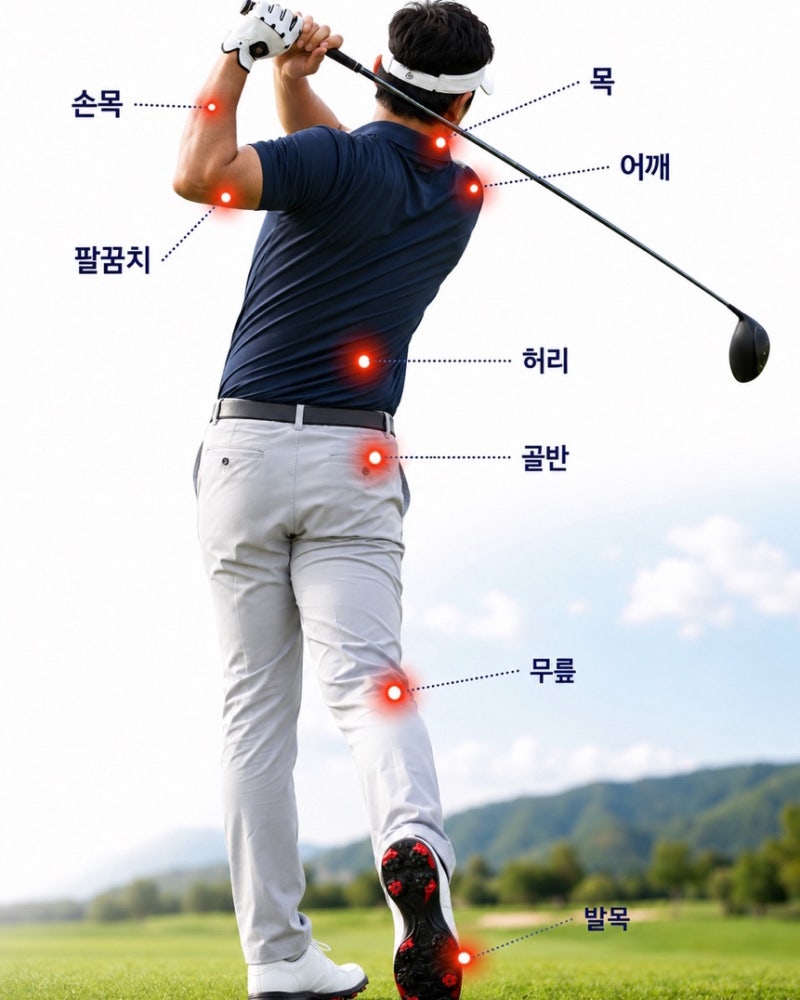
However, a real golf swing is a complex rotational movement that involves the entire body – from the neck, back, lower back, pelvis, shoulders, wrists, knees, to the ankles – all moving together in a short moment. During the swing, torso rotation, weight transfer, the force of pushing off the ground, and the impact of the club hitting the ball all act simultaneously. If this process is repeated, strain accumulates in specific areas, which can lead to various musculoskeletal pains after a round.
The lower back is especially the most common area of discomfort reported after golf. Therefore, if lower back pain recurs after golf, it’s necessary to distinguish whether it’s simple fatigue or a problem with the surrounding tissues and movements of the lower back. Recurring pain can be a sign that movement somewhere in the body is insufficient, or that a specific area is constantly overcompensating.
The Impact of Golf on the Musculoskeletal System: A Sport where multiple joints move in sequence. A golf swing is a movement where various joints of the body move in sequence. The foot pushes off the ground, the knees and hip joints absorb the rotation, the pelvis and lower back turn, and the force is transmitted through the back and shoulders to the wrist.
If the movement of any one part in this connected process is insufficient or excessive, other parts will bear the compensatory strain. For example, if you repeatedly swing with insufficient hip joint rotation, your lower back may twist more. If thoracic rotation (i.e., in the back) is insufficient, it’s easy for tension to build up around the shoulders and neck.
Swings that overuse the wrist can strain the wrist joint and tendons. In other words, it’s important to view post-golf pain not as a problem of just one area, but as a connected issue of movement extending from the ankles to the knees, hip joints, pelvis, spine, shoulders, and wrists. Therefore, in Suji-gu pain treatment, it’s necessary to not just identify the painful area, but also to examine why that area is repeatedly strained and which connections in the body are blocked during the swing.
Spinal Pain: Is Post-Golf Lower Back Pain Solely a Lower Back Problem?
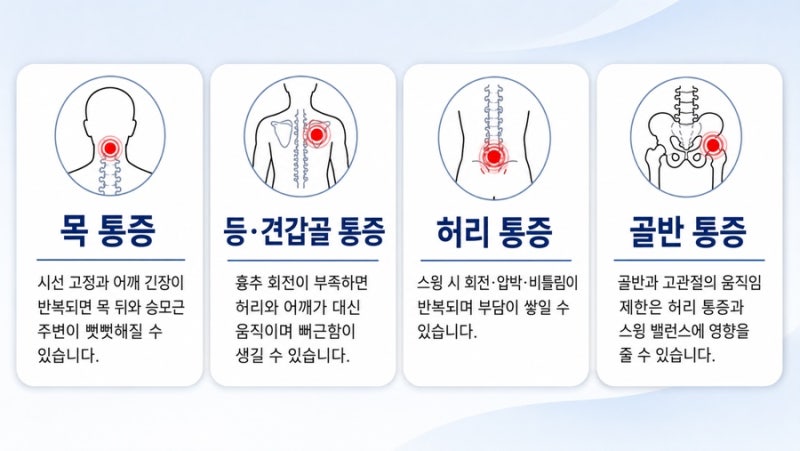
Post-Golf Lower Back Pain: Post-Golf Lower Back Pain. The lower back is one of the most common areas of discomfort reported after golf. A swing involves rotating the lower back to one side and then quickly turning it back in the opposite direction. At this time, not only rotational force but also compression and twisting act simultaneously on the lower back.
If you typically have weak lower back muscles, insufficient hip and pelvic movement, or a sedentary lifestyle, lower back pain may appear more easily after a round. Post-golf lower back pain might feel like simple muscle tightness. However, if it recurs, it could be a sign that strain is accumulating in the muscles, ligaments, facet joints, and tissues around the lumbar spine and discs.
Especially if you have these symptoms, it’s best not to dismiss them as mere fatigue. Sometimes, there’s pain when straightening the back after a swing, a heavy feeling in the lower back after walking for a long time, or lower back pain that persists for several days after a round. Additionally, a pulling sensation may accompany it in the buttocks and legs, or the pain may improve with rest but recur when playing golf again.
Pain in the back and around the shoulder blades is also common. Thoracic rotation (i.e., in the back) is very important in a golf swing, and if this area doesn’t rotate well, the lower back and shoulders will compensate. In such cases, you might experience stiffness in the middle of your back, tightness around the shoulder blades, and even stiffness extending to your neck and shoulders.
Neck pain is often related to swing posture, neck pain is often related to swing posture, fixed gaze, and shoulder tension. If torso rotation is repeated while the neck is fixed to keep an eye on the ball until the end, tension accumulates around the back of the neck and trapezius muscles. Therefore, if lower back pain recurs after golf, it’s necessary to check not only the lower back but also the movements of the pelvis, hip joints, thoracic spine, neck, and shoulders. Joint Pain: Reasons for Shoulder, Wrist, and Knee Pain After Golf
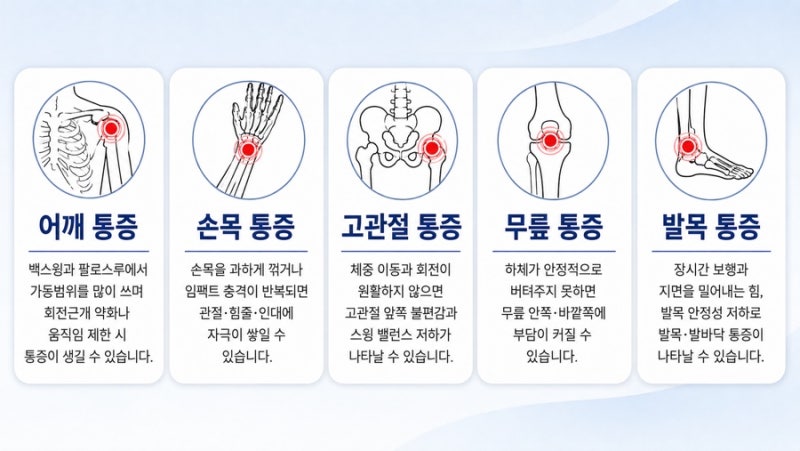
Post-golf joint pain primarily appears in the shoulders, wrists, hip joints, knees, and ankles. The shoulders utilize a large range of motion during the backswing and follow-through. If the shoulder joint doesn’t move sufficiently or the rotator cuff muscles are weak, pain may develop in the front or outer part of the shoulder after a swing.
There might be a catching sensation when lifting the arm, or throbbing pain in the shoulder at night. Wrist pain also occurs frequently. During a swing, the wrist plays a role in controlling the club’s direction and power.
However, if the wrist is excessively bent, impact shocks are repeated, or many balls are hit repeatedly at the driving range, irritation can accumulate in the wrist joint, tendons, and ligaments. Hip and knee pain are related to weight transfer and rotational movements. If the lower body doesn’t stably support during the swing, the knee might collapse inward, or the hip joint might not rotate sufficiently, leading to pain.
If you already have knee arthritis or a misaligned pelvic balance, the inner or outer knee, or the front of the hip joint, may become uncomfortable after a round. Ankle and foot pain are related to prolonged walking during a round, sloped terrain, and the force of pushing off the ground during a swing. Golf involves more walking than one might think.
If ankle stability is poor or the arch of the foot is weak, ankle, calf, and foot pain may appear after a round. As such, post-golf pain is often not just a problem of the lower back alone, but rather arises from the interconnected influence of the spine, joints, tendons, and fascia. Suji-gu Pain Treatment: How do we approach post-golf pain?
Acupuncture, Pharmacopuncture, Acupotomy, Chuna Manual Therapy, Herbal Medicine Treatment. In Korean medicine, post-golf pain is not assessed by looking at just one painful area. If the lower back hurts, we also examine pelvic rotation, hip joint movement, and thoracic stiffness. If the shoulder hurts, we also check the rotator cuff, joint capsule, scapular movement, and tension in the neck and back.
If the wrist, knee, or ankle hurts, we also check swing habits, weight transfer, lower body stability, and walking strain. At Sunyujae Korean Medicine Clinic, we consider acupuncture, pharmacopuncture, acupotomy, Chuna manual therapy, and herbal medicine treatment, among others, depending on the patient’s condition.
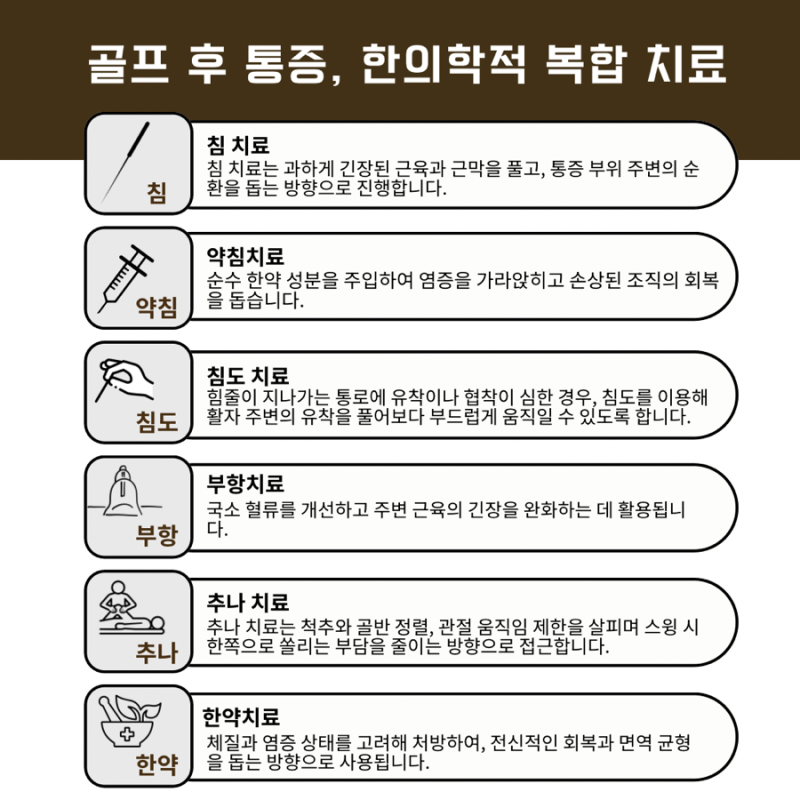
1. Acupuncture Treatment. Acupuncture treatment aims to relax overly tense muscles and fascia and promote circulation around the painful area. It can be applied in cases where excessive muscle and fascial tension occurs, such as post-golf lower back pain, shoulder stiffness, and wrist tension.
2. Pharmacopuncture Treatment. Pharmacopuncture treatment can be used to help alleviate pain and promote recovery, depending on the condition of the tendons, ligaments, and surrounding joint tissues. For conditions like shoulder pain, wrist pain, or knee pain, where repetitive strain has accumulated in a specific area, the treatment direction is determined after assessing the patient’s condition.
3. Acupotomy Treatment. Acupotomy treatment is a precise approach that addresses problems around adhered or tense soft tissues, fascia, and tendons. If post-golf pain recurs for a long time, or if a specific area continuously feels tight and stiff, it’s necessary to check if it’s not just simple muscle soreness but also involves tissue tension, adhesion, and restricted movement.
4. Chuna Manual Therapy. Chuna manual therapy examines spinal and pelvic alignment and restricted joint movement, approaching treatment in a way that reduces the one-sided strain during a swing. Among those who experience recurring lower back pain after golf, it’s often not just a lower back problem, but also involves restricted movement in the pelvis and hip joints.
5. Herbal Medicine Treatment. Herbal medicine prescriptions are tailored to the individual’s condition, considering pain patterns, physical strength, recovery speed, and sleep status. If pain persists for a long time or recovery is slow, or if fatigue and poor sleep are also present, it may be necessary to assess the overall bodily condition.
Even for the same post-golf pain, the causes vary from person to person. Therefore, in Suji-gu pain treatment, it’s important to consider not only the painful area but also the body’s overall movement and recovery status. Sometimes, post-golf pain improves if you endure it.
However, if the same area repeatedly hurts, or if pain returns after resting and then playing golf again, it’s difficult to consider it mere muscle soreness. Especially if lower back pain, shoulder pain, wrist pain, or knee pain recurs after golf, it’s necessary to check how your body is currently moving.
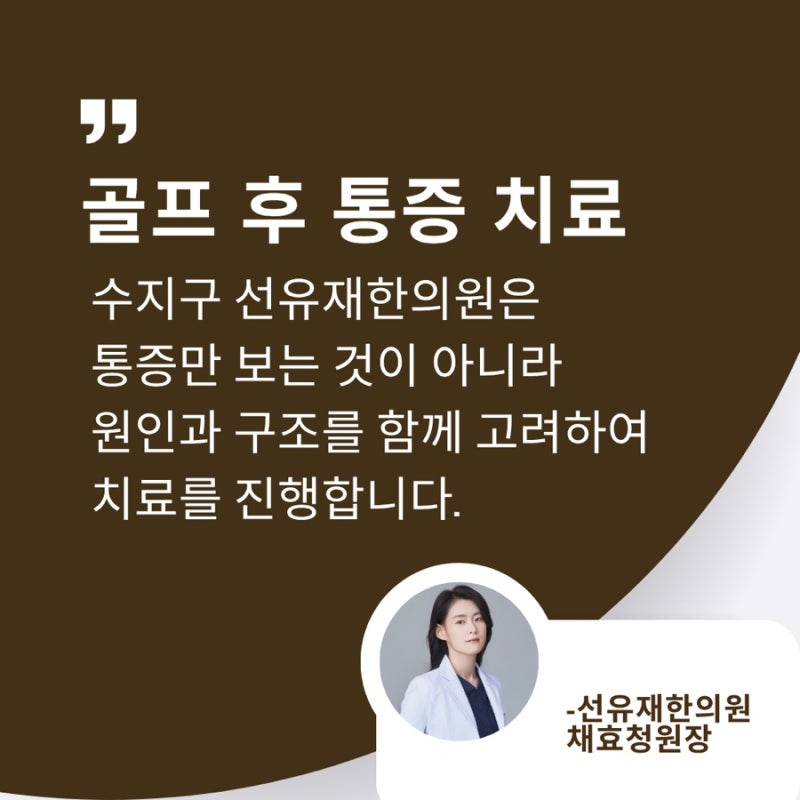
At Sunyujae Korean Medicine Clinic in Suji-gu, we don’t just look at the painful area after golf; we also examine repetitive movements in the swing, spinal and pelvic rotation, and the strain on the shoulders, wrists, and knees. If you are considering pain treatment in Suji-gu, we recommend checking the signals your body is sending rather than just enduring it.
https://m.blog.naver.com/sunyujae21/224281319890
We hope you will join Sunyujae Korean Medicine Clinic, which shares valuable information for a healthy life. Sunyujae Korean Medicine Clinic in Suji-gu pursues evidence-based medicine and integrative medicine.
This post was written directly by the medical staff of Sunyujae Korean Medicine Clinic to provide medical information, in compliance with Article 56(2) and Article 57(3) of the Medical Service Act. The duration and outcome of treatment may vary from person to person, so please consult a qualified practitioner before beginning treatment.
Consultation & Booking
Have questions? Reach us anytime via KakaoTalk or phone.