
![[선유재한의원] 근본을 치료하는 한의원 불면증 치료](https://syjkmc.kr/wp-content/uploads/2026/06/224283478255_img_0.jpeg)
Hello, this is Sunyujae Korean Medicine Clinic, where kind hearts reside.

In our previous post, we discussed the causes and symptoms of insomnia. Many people rely on medication to alleviate the nightly suffering of sleeplessness, and one of the most commonly used drugs is Zolpidem. While Zolpidem is effective in helping you fall asleep quickly, long-term use can lead to other problems such as dependence, tolerance, and side effects.
While it may offer short-term relief, is this truly a sustainable solution? In this post, we will discuss how Western medicine and Korean medicine approach and treat insomnia differently, as well as precautions and alternatives to Zolpidem use. We hope this will be a time to consider ways to move beyond simple sleep induction and restore the balance of body and mind to enable you to fall asleep naturally.
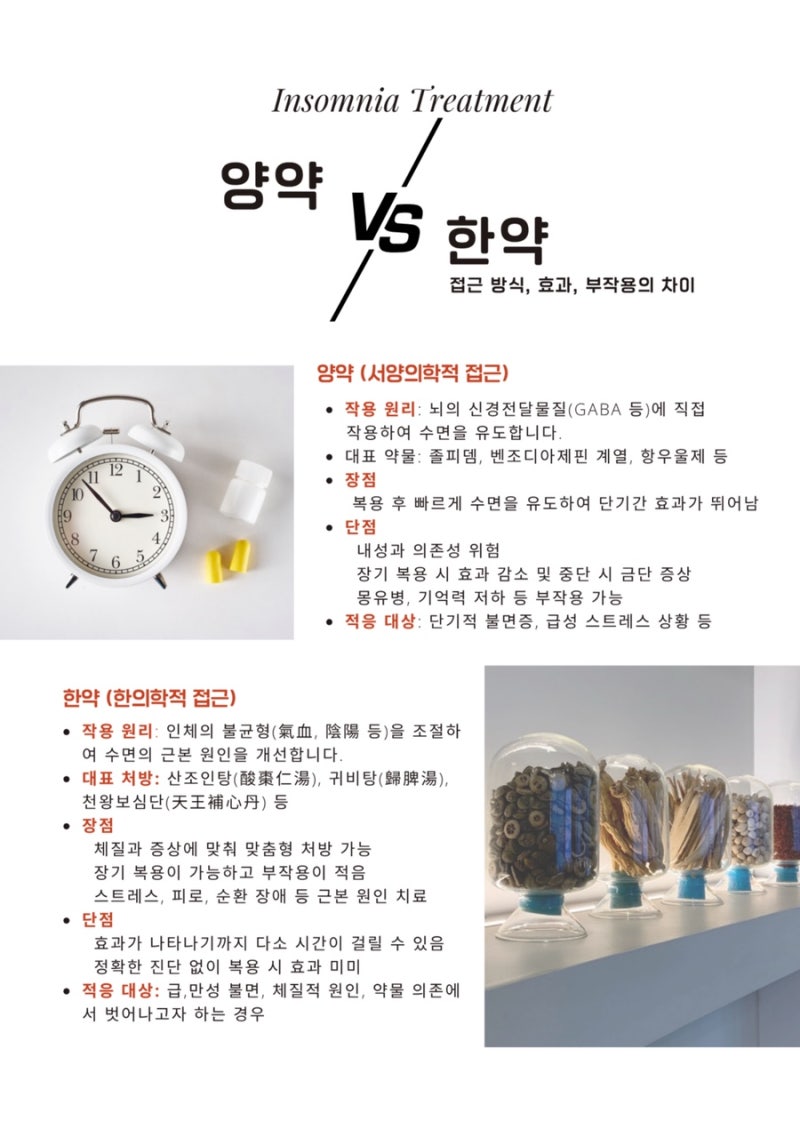
Differences in Approach, Efficacy, and Side Effects Between Western and Herbal Medicine for Insomnia Treatment Herbal Medicine (Korean Medicine Approach) – Mechanism of Action: It regulates imbalances in the body (such as Qi and Blood, Yin and Yang) to improve the fundamental causes of sleep problems. – Representative Prescriptions: Sanjoin-tang (酸棗仁湯), Gwibi-tang (歸脾湯), Cheonwangbosim-dan (天王補心丹), etc. Advantages – Customized prescriptions tailored to constitution and symptoms – Suitable for long-term use with fewer side effects – Treats underlying causes such as stress, fatigue, and circulatory disorders
Disadvantages – May take some time for effects to appear – Minimal effect if taken without accurate diagnosis – Suitable for: Acute and chronic insomnia, constitutional causes, or those seeking to overcome drug dependence. Western Medicine (Western Medical Approach) – Mechanism of Action: Directly acts on neurotransmitters in the brain (such as GABA) to induce sleep.
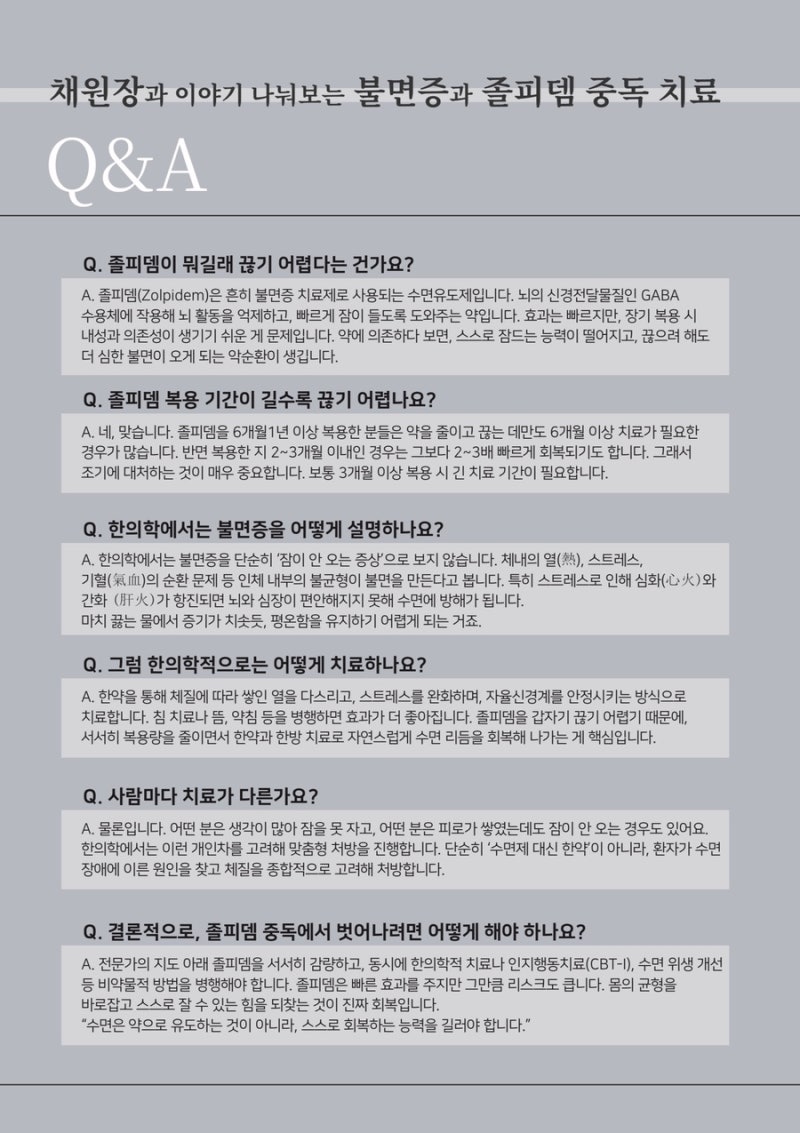
– Representative Medications: Zolpidem, benzodiazepines, antidepressants, etc. Advantages – Rapidly induces sleep after administration, excellent for short-term effects Disadvantages – Risk of tolerance and dependence – Decreased efficacy with long-term use and withdrawal symptoms upon discontinuation – Possible side effects such as sleepwalking and memory impairment – Suitable for: Short-term insomnia, acute stress situations, etc. Q&A with Dr. Chae on Insomnia and Zolpidem Addiction Treatment Q. What is Zolpidem, and why is it so difficult to quit?
A. Zolpidem is a hypnotic commonly used to treat insomnia. It works by acting on GABA receptors, a neurotransmitter in the brain, to suppress brain activity and help you fall asleep quickly. While its effects are fast, long-term use can lead to
tolerance and dependence, which is the problem. Relying on the medication can diminish your ability to fall asleep on your own, creating a vicious cycle where attempting to quit leads to even more severe insomnia. Q. Is it harder to quit Zolpidem the longer you take it?
A. Yes, that’s correct. For individuals who have taken Zolpidem for 6 months to over a year, it often takes more than 6 months of treatment just to reduce and discontinue the medication.
On the other hand, those who have taken it for less than 2-3 months may recover 2-3 times faster. Therefore, early intervention is crucial. Generally, taking it for more than 3 months requires a longer treatment period.
Q. How does Korean medicine explain insomnia? A. In Korean medicine, insomnia is not simply viewed as ‘the inability to sleep.’
It is believed that internal imbalances in the body, such as heat (熱), stress, and issues with the circulation of Qi and Blood (氣血), lead to sleeplessness. Specifically, when Heart Fire (心火) and Liver Fire (肝火) are overactive due to stress, the brain and heart cannot relax, disrupting sleep. It’s like steam rising from boiling water, making it difficult to maintain tranquility.
Q. So, how is it treated in Korean medicine? A. Through herbal medicine, we manage accumulated heat according to the individual’s constitution, alleviate stress, and
treat by stabilizing the autonomic nervous system. Combining this with acupuncture, moxibustion, or pharmacopuncture can enhance the effects. Since it’s difficult to stop Zolpidem abruptly, the key is to gradually reduce the dosage while using herbal medicine and Korean medicine treatment to naturally restore the sleep rhythm.
Q. Is the treatment different for each person? A. Of course.
Some people can’t sleep because they have too many thoughts, while others can’t sleep even when they’re exhausted. In Korean medicine, we consider these individual differences to provide personalized prescriptions. It’s not simply ‘herbal medicine instead of sleeping pills,’ but rather finding the root cause of the patient’s sleep disorder and prescribing based on a comprehensive assessment of their constitution.
Q. In conclusion, how can one overcome Zolpidem addiction? A. Under the guidance of a specialist, gradually reduce Zolpidem dosage, and
simultaneously combine non-pharmacological methods such as Korean medicine treatment, cognitive behavioral therapy for insomnia (CBT-I), and improved sleep hygiene. While Zolpidem offers quick effects, its risks are equally significant. True recovery means restoring the body’s balance and regaining the ability to sleep on your own.
“Sleep should not be induced by medication, but rather by cultivating the body’s own ability to recover.” https://m.blog.naver.com/sunyujae21/223865103316
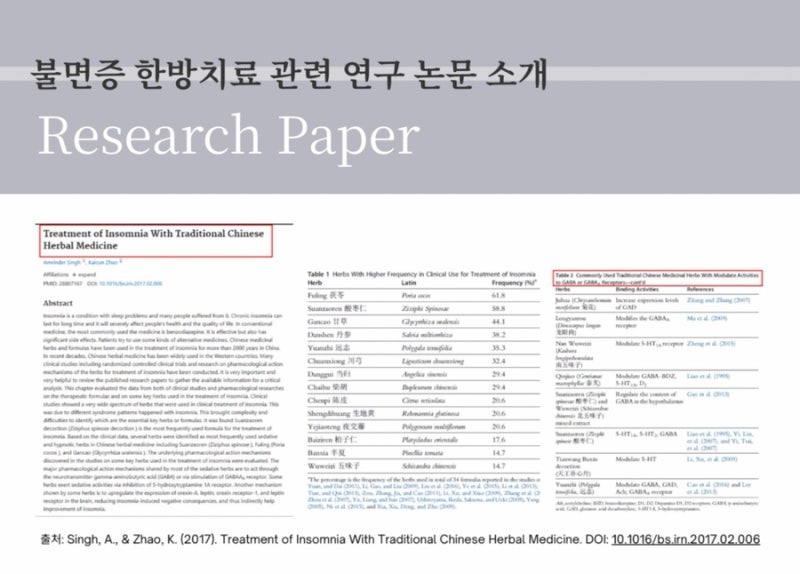
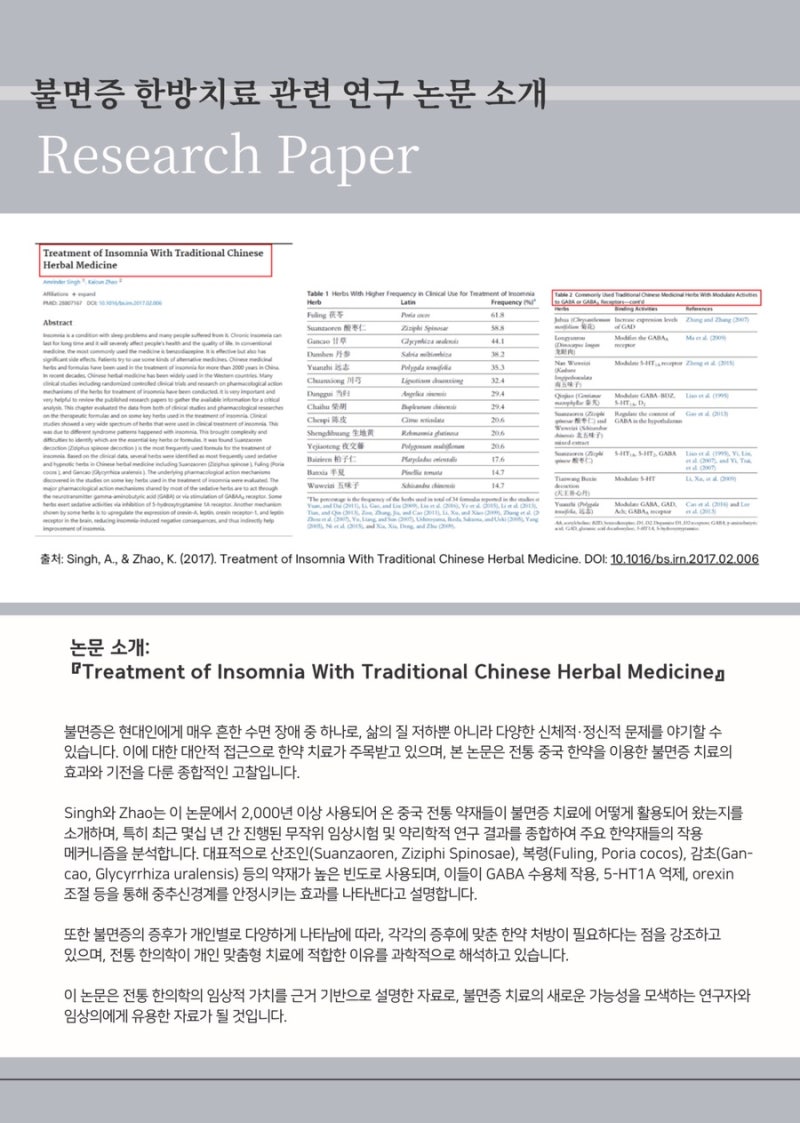
Paper Introduction: 『Treatment of Insomnia With Traditional Chinese Herbal Medicine』 Insomnia is one of the most common sleep disorders among modern people, leading not only to a decrease in quality of life but also to various physical and mental problems. As an alternative approach, herbal medicine treatment is gaining attention, and this paper is a comprehensive review of the efficacy and mechanisms of treating insomnia using traditional Chinese herbal medicine.
In this paper, Singh and Zhao introduce how traditional Chinese herbal medicines, used for over 2,000 years, have been utilized in treating insomnia. They specifically analyze the mechanisms of action of key herbal medicines by synthesizing the results of randomized clinical trials and pharmacological studies conducted over the past few decades. Representative herbs such as Suanzaoren (Ziziphi Spinosae), Fuling (Poria cocos), and Gancao (Glycyrrhiza uralensis) are
frequently used, and they explain that these herbs exhibit central nervous system stabilizing effects through mechanisms such as GABA receptor activation, 5-HT1A inhibition, and orexin regulation. Furthermore, they emphasize the necessity of personalized herbal medicine prescriptions tailored to each individual’s diverse insomnia symptoms, scientifically interpreting why traditional Korean medicine is suitable for personalized treatment.
This paper serves as evidence-based documentation explaining the clinical value of traditional Korean medicine, and it will be a useful resource for researchers and clinicians exploring new possibilities in insomnia treatment.
We hope you will join Sunyujae Korean Medicine Clinic in sharing valuable information for a healthy life. Sunyujae Korean Medicine Clinic in Suji-gu pursues evidence-based medicine and integrative medicine.
This post was written directly by the medical staff of Sunyujae Korean Medicine Clinic to provide medical information, in compliance with Article 56(2) and Article 57(3) of the Medical Service Act. The duration and outcome of treatment may vary from person to person, so please consult a qualified practitioner before beginning treatment.
Consultation & Booking
Have questions? Reach us anytime via KakaoTalk or phone.