
Understanding Acupotomy Treatment Principles through Nerve Adhesion and Nerve Gliding
You may have experienced feeling better after treatment, only for the same area to become uncomfortable again over time. The nerves in our bodies are not fixed in place. They are designed to move along with our joints and muscles whenever we move. However, some people experience tingling and pulling sensations every time they move. Today, I will explain where this misalignment begins and how acupotomy treatment addresses it.
Peripheral Nerve Pain: Compression Is Not the Only Cause
For a long time, peripheral nerve pain was often understood as a problem caused by nerve compression. Nerve compression is still one of the important causes. However, in actual clinical practice, there are many cases that cannot be explained by compression alone. These include cases where pain temporarily improves after treatment but then returns, worsens when maintaining the same posture for a long time, or changes symptoms when changing posture. Nerves pass between surrounding tissues such as muscles, ligaments, fascia, and blood vessels, moving along with the body’s movements. This movement, where nerves glide between surrounding tissues, is called nerve gliding.
In a normal state, when a nerve moves, the surrounding tissues also move flexibly, distributing tension. However, if adhesion (perineural tethering) occurs in the tissues surrounding the nerve due to repetitive use, trauma, inflammation, or post-surgical changes, gliding can be restricted. When nerve gliding is restricted, friction with surrounding tissues increases with every movement, and the tension and mechanical stress on the nerve can also intensify. If this process repeats, an environment where pain and tingling easily recur or become chronic can be created. In other words, peripheral nerve pain requires considering not only problems with the nerve itself but also changes in the surrounding environment through which the nerve passes. Therefore, recently, an approach that evaluates not only nerve compression but also nerve gliding and the condition of surrounding tissues together is considered important.
What Role Do Tissues Surrounding Nerves Play?
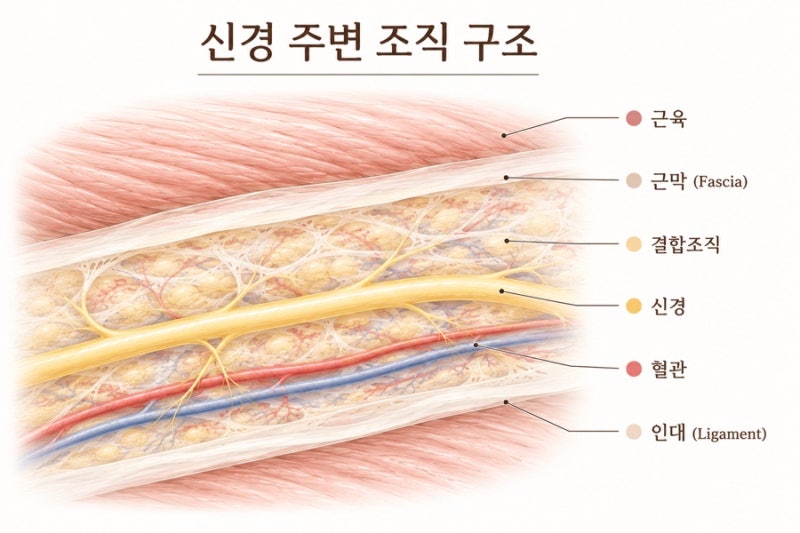
Surrounding nerves are muscles, fascia, ligaments, blood vessels, and loose connective tissue. These tissues do not merely enclose the nerve; they collectively create an environment in which the nerve moves and functions. Muscles generate movement and protect the nerve from external impact. Fascia and ligaments support the path of the nerve, maintaining its stable position relative to surrounding tissues. Blood vessels supply oxygen and nutrients to the nerve and surrounding tissues, while connective tissue provides space for the nerve and blood vessels to move without friction.
In a normal state, these tissues work in harmony, helping the nerve to move naturally (glide) between them. With every movement, tension on the nerve is distributed, and necessary blood flow is smoothly maintained. However, if repetitive use, trauma, inflammation, or post-surgical changes continue, adhesion (perineural tethering) can occur in the tissues surrounding the nerve. When adhesion occurs, the flexibility of the fascia and connective tissue decreases, and friction and tension with surrounding tissues increase every time the nerve moves. During this process, blood flow can decrease, and tissue recovery may slow down. If these changes repeat, nerve gliding becomes restricted, creating an environment where pain worsens in the same posture or tingling recurs. Therefore, recently, it has become important to evaluate not only the nerve itself but also the condition of the surrounding tissues through which the nerve passes and the gliding environment.
Nerve Adhesion: Why Pain Recurs
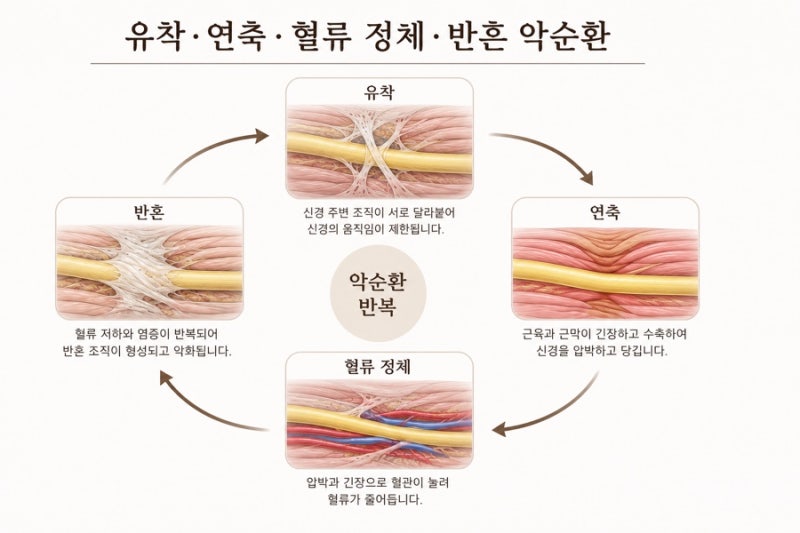
When nerve movement is restricted, pain can recur in a cyclical pattern. First, adhesion occurs, where the nerve sticks to surrounding tissues, limiting its movement. In this state, moving the body repeatedly applies greater tension and pressure to the nerve. This leads to congestion, meaning poor blood circulation in the tissues, followed by edema and inflammation. If recovery is insufficient, the tissue hardens, leaving behind fibrosis (fibrotic fixation). This fibrosis, in turn, exacerbates the adhesion, returning to the beginning of the cycle. As this cycle repeats, pain easily becomes chronic and prone to recurrence. This is also why simply relieving compression alone does not break the entire cycle.
What Is Nerve Gliding?
Nerves are not fixed structures like electrical wires. Even when you turn your neck, bend your back, move your wrist, or lift your leg, nerves naturally move between muscles, ligaments, and fascia, distributing tension. This movement is called nerve gliding. When gliding is smooth, the nerve moves gently without being stretched more than necessary. Conversely, if gliding is restricted, the nerve can be pulled and tension can increase with every movement, leading to recurring pain. Indeed, a study observing the movement of the sciatic nerve during nerve mobilization using ultrasound imaging reported differences in the extent of nerve movement depending on the mobilization technique.
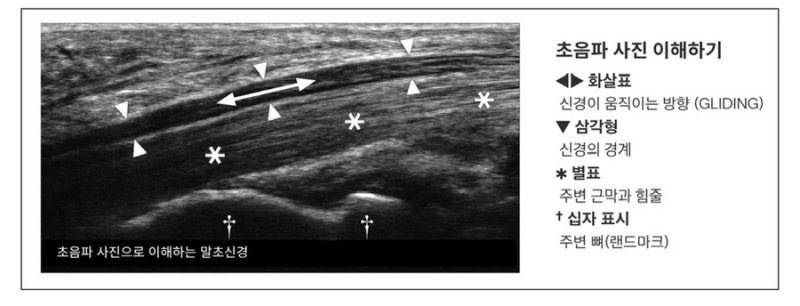
This data demonstrates that nerve gliding is a measurable phenomenon and that its extent can vary depending on how movement is induced. This movement can be directly observed with ultrasound. On the screen, arrows indicate the direction of nerve movement, triangles mark the nerve boundaries, asterisks represent surrounding fascia and tendons, and cross marks indicate surrounding bones (landmarks). In a normal state, the nerve glides freely between surrounding tissues, but in an adhered state, the nerve appears stuck to the tissue, with restricted movement.
Why Is Ultrasound-Guided Acupotomy Treatment Necessary?
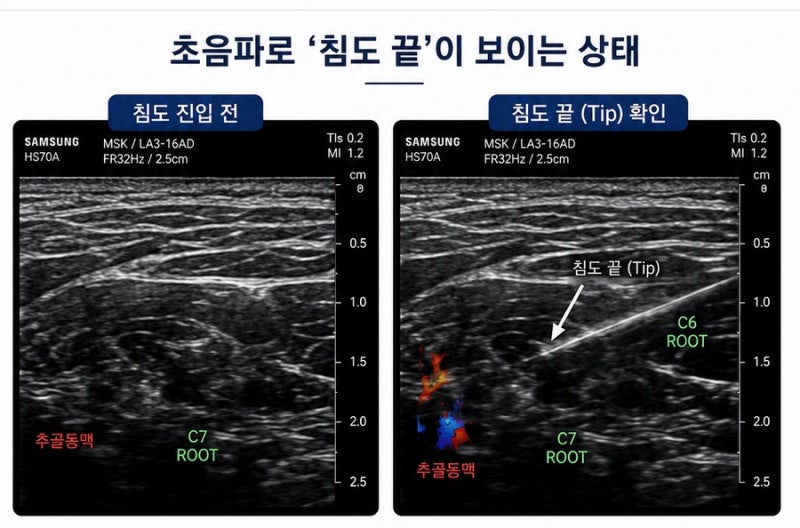
We do not treat unseen areas based on guesswork. Sunyujae Korean Medicine Clinic directly verifies with ultrasound before, during, and after treatment. Using ultrasound, we identify both the target tissue to be treated and structures to avoid (No-go), plan a safe access plane, and then track the acupotomy tip in real-time. This process allows us to precisely treat only the target tissue while protecting surrounding healthy tissues. This is where treatment without verification differs from treatment with verification.
I’m Curious About Acupotomy Treatment
Acupotomy is a treatment that uses a tool with a fine blade (刀) to release adhered or fibrotic tissues. The goals of acupotomy treatment are threefold: to carefully release tissues stuck around the nerve, to restore the movement of tissues restricted by adhesion and help the nerve regain its gliding ability, and to restore an environment where the nerve and surrounding tissues can move naturally again. Unnecessary damage is minimized, and only the precise area is accessed. The goal of acupotomy is to release adhesions around the nerve to naturally restore nerve gliding.
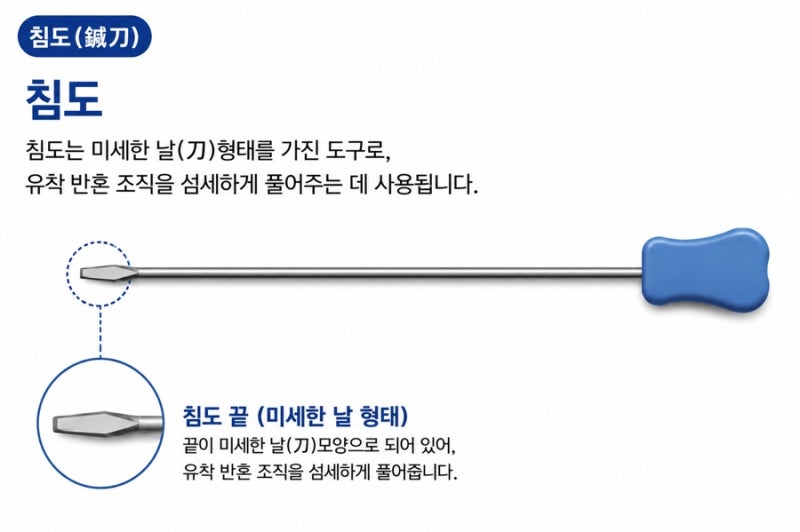
How does acupotomy differ from general acupuncture and pharmacopuncture? General acupuncture is a treatment that helps control pain and restore function through stimulation. Acupotomy, on the other hand, focuses on subtly releasing adhered soft tissues to restore tissue movement. Its role also differs from pharmacopuncture. Acupotomy is a treatment that improves the mechanical environment of tissues, while pharmacopuncture is a treatment that controls inflammation and aids recovery. Because they act on different levels, they can be used complementarily together.
Why does Sunyujae Korean Medicine Clinic prioritize movement? Both Dr. Hyocheong Chae and Dr. Kwangho Kim of Sunyujae Korean Medicine Clinic are members of the Korean Acupotomy Medical Society, sharing the same acupotomy techniques and treatment philosophy to treat patients’ pain. The body does not move in isolated parts. We must consider the entire path of the nerve, including the muscles, fascia, ligaments, and blood vessels that form that path. Sunyujae Korean Medicine Clinic’s principle of treatment is to examine not just the site of pain, but also the reasons behind that pain and the surrounding nerve environment.
Acupotomy Treatment: Frequently Asked Questions
Is acupotomy a surgical procedure? No. Acupotomy is a minimally invasive treatment, different from incisional surgery, and its applicability varies depending on the disease and condition.
What types of pain does acupotomy treatment apply to? It is considered for musculoskeletal pain when adhesion or fibrosis of tissues around the nerve is identified as the cause of pain. It is not a treatment applicable to all types of pain and is decided after examination and ultrasound confirmation.
Can nerve adhesion be confirmed with ultrasound? Ultrasound is used to evaluate the nerve’s location, the condition of surrounding tissues, and movement, helping to formulate a treatment plan.
Is acupotomy very painful? The sensation may vary depending on the treatment area and the degree of adhesion.
How many acupotomy treatments are typically received? It depends on the degree and duration of the adhesion. Mild adhesions may show improvement with a small number of sessions (1-3), but chronic adhesions often require multiple sessions spread out over time.
Should acupotomy and pharmacopuncture be received together? In some cases, they may be considered together depending on the patient’s condition. If adhesion is the primary concern, acupotomy is prioritized; if more inflammation control is needed, pharmacopuncture may be prioritized.
Nerves are not fixed structures but tissues that glide between surrounding tissues. When adhesion occurs, it restricts nerve movement, leading to recurring pain and tingling. In such cases, releasing the adhesion to restore nerve movement is key to pain treatment.
— Dr. Hyocheong Chae, Chief Director, Sunyujae Korean Medicine Clinic
Restoring an environment where the body can move naturally again—that is how Sunyujae Korean Medicine Clinic views acupotomy.
Key Takeaways
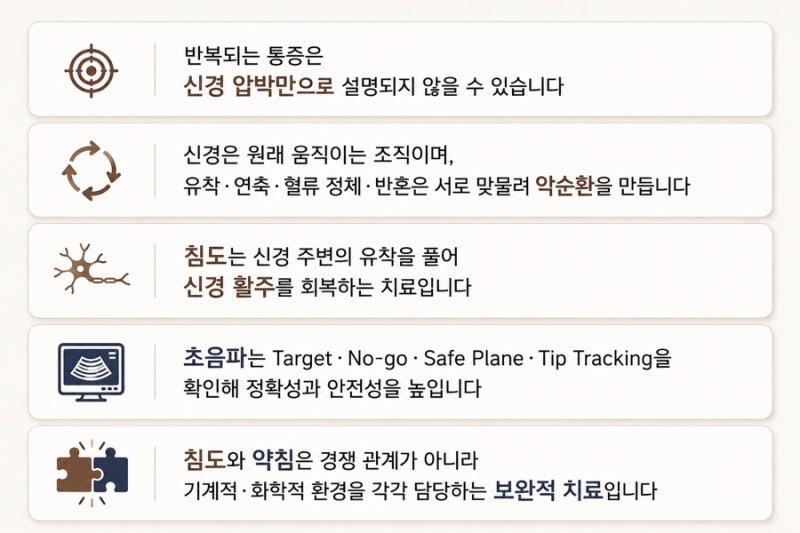
- Recurring pain may not be explained by nerve compression alone.
- Nerves are inherently mobile tissues, and adhesion, spasm, congestion, and fibrosis interlock to create a vicious cycle.
- Acupotomy is a treatment that releases adhesions around the nerve to restore nerve gliding.
- Ultrasound enhances accuracy and safety by confirming the Target, No-go, Safe Plane, and Tip Tracking.
- Acupotomy and pharmacopuncture are not competing treatments but complementary therapies, each addressing the mechanical and chemical environments, respectively.
References
- Ellis RF, Hing WA, McNair PJ. Comparison of longitudinal sciatic nerve movement with different mobilization exercises: an in vivo study utilizing ultrasound imaging. J Orthop Sports Phys Ther. 2012;42(8):667–675.
- Lam KHS, Hung CY, Chiang YP, Onishi K, Su DCJ, Clark TB, Reeves KD. Ultrasound-Guided Nerve Hydrodissection for Pain Management: Rationale, Methods, Current Literature, and Theoretical Mechanisms. J Pain Res. 2020;13:1957–1968.
We hope you will join Sunyujae Korean Medicine Clinic in sharing valuable information for a healthy life. Sunyujae, a Korean medicine clinic in Suji-gu, pursues evidence-based medicine and integrative medicine.
This post was written directly by the medical staff of Sunyujae Korean Medicine Clinic to provide medical information, in compliance with Article 56(2) and Article 57(3) of the Medical Service Act. The duration and outcome of treatment may vary from person to person, so please consult a qualified practitioner before beginning treatment.
Consultation & Booking
Have questions? Reach us anytime via KakaoTalk or phone.