Some people tire easily and feel that their stamina no longer returns as it used to, even after rest. This often leads them to look into Gyeongokgo as a restorative formula for their parents, a holiday gift, or support for the stamina of students preparing for exams and people at work.
Once they start looking into Gyeongokgo, questions arise about how long it has been used, what it contains, and how it differs from Gongjindan. During consultations, we also frequently hear: “Who is Gyeongokgo suitable for?” and “How is it different from Gongjindan?”
Here, we discuss historical records of Gyeongokgo, its ingredients, the features of ES Deer Antler Velvet Gyeongokgo, its differences from Gongjindan, and common questions about taking it.
Was Gyeongokgo Used During the Joseon Period?
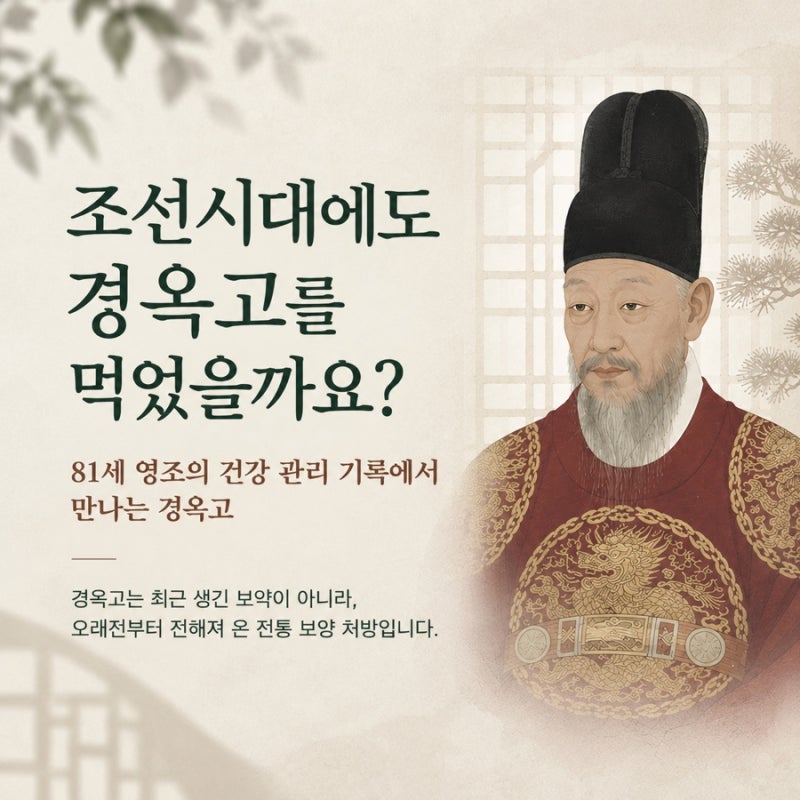
Gyeongokgo is not a recently developed restorative formula. It appears in historical medical texts and in records of health care within the Joseon royal court.
Yeongjo, the 21st king of Joseon, is known as a long-lived king who lived to the age of 81. He took an interest in his physical condition, diet, and daily habits and used various prescriptions to manage his health. Gyeongokgo is among the formulas mentioned in these records.
However, Yeongjo’s longevity cannot be explained by Gyeongokgo alone. Nor does this mean that Gyeongokgo was first developed during his reign.
The significance is that a traditional restorative formula passed down from an earlier period also appears in records of royal health care.
Why Was Gyeongokgo So Highly Valued in the Past?
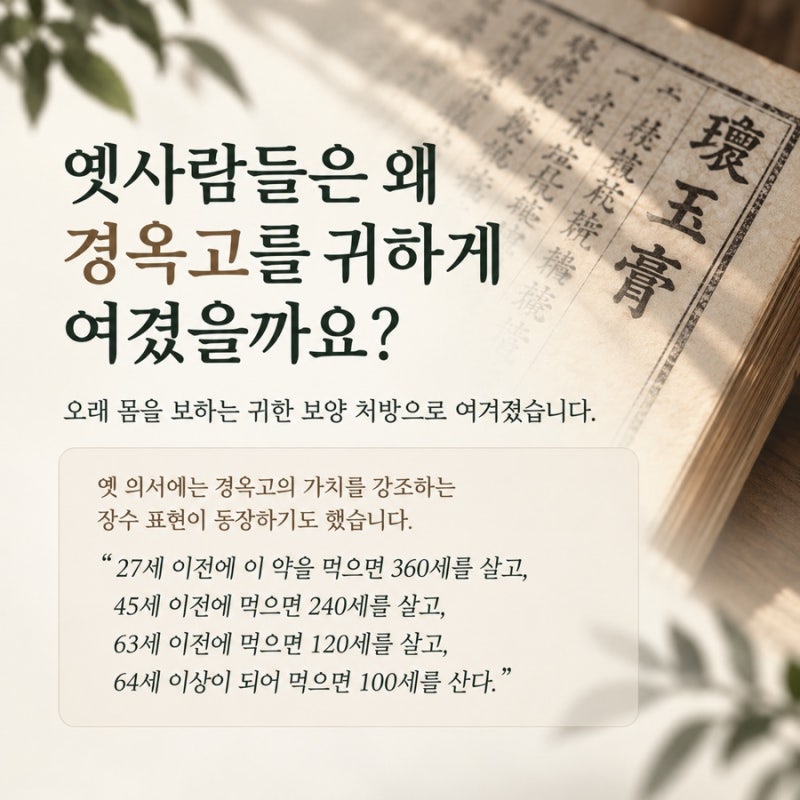
Some historical medical texts describe Gyeongokgo using expressions about lifespan that appear exaggerated by today’s standards, such as claims that taking it before a certain age would allow a person to live for hundreds of years.
It would be inappropriate to interpret these statements as meaning that taking Gyeongokgo actually produces a dramatic increase in lifespan.
Writers at the time sometimes used references to long life and longevity to emphasize the value of a highly regarded formula.
These records are therefore better understood in their historical context: Gyeongokgo was valued as a formula for nourishing the body and managing health. They should not be read as modern descriptions of its efficacy.
What Does “Yangseong Yeonnyeon Yagi” Mean?
Classical records concerning Gyeongokgo also contain the expression “yangseong yeonnyeon yagi”. Although the phrase may seem unfamiliar, its meaning is close to the traditional concept of nurturing health: caring for the body through food and medicine to maintain health and age well.
For people in the past, restorative care did not simply mean taking a tonic once the body was already exhausted. It was understood more broadly to include attention to everyday diet and habits, with food and prescriptions used according to the person’s condition.
Gyeongokgo can also be understood within this tradition of caring for health.
What Is Gyeongokgo Made From?
Traditional Gyeongokgo is a thick herbal paste prepared from four basic ingredients: fresh rehmannia root, ginseng, white poria, and honey.
“Go” refers to a thick paste made by decocting and preparing medicinal ingredients.
The four ingredients are not simply a mixture of several tonic herbs. They are combined according to traditional formulation principles.
Fresh rehmannia root is one of the principal ingredients in Gyeongokgo. In Korean medicine, it has long been used with the aim of nourishing bodily fluids.
Ginseng is a well-known restorative ingredient used in Korean medicine when considering states of low energy and easy fatigue.
White poria is another traditional ingredient in Gyeongokgo. In Korean medicine, it has been used in formulas that address the spleen and stomach and the handling of fluids and dampness.
Honey is included not only for sweetness, but also to blend the ingredients harmoniously and help produce the paste formulation.
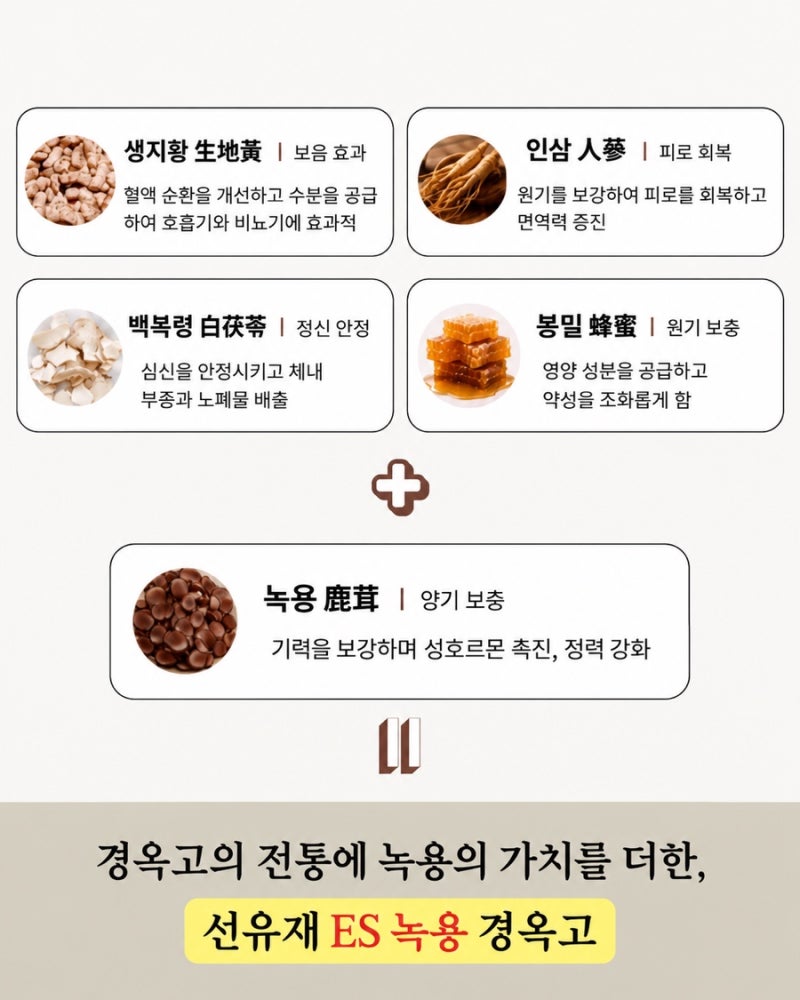
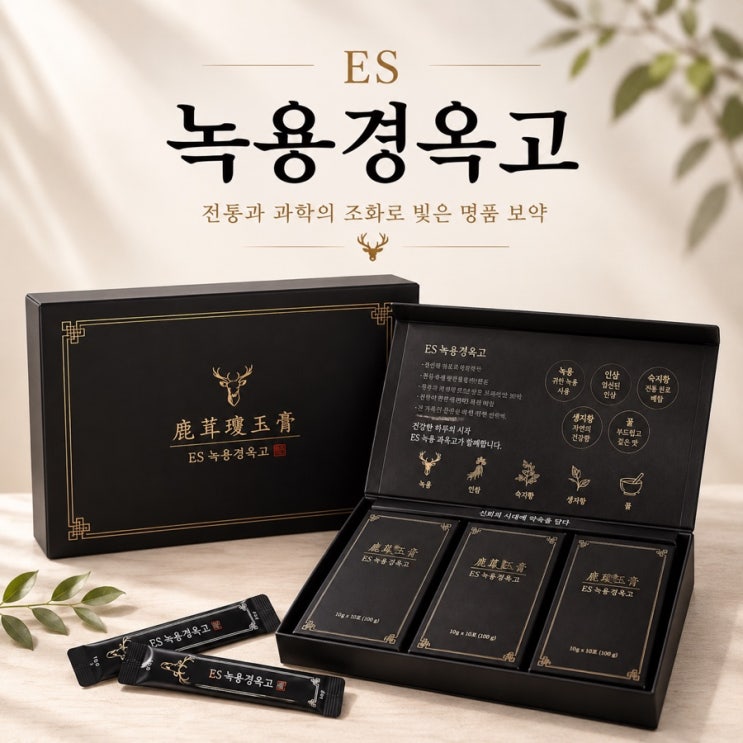
ES Deer Antler Velvet Gyeongokgo
Sunyujae Korean Medicine Clinic also uses ES Deer Antler Velvet Gyeongokgo, which adds deer antler velvet to this basic Gyeongokgo formula.
Even within a single antler, the tissue is not uniform from top to bottom. Its sections are referred to by terms such as bungol, sangdae, and hadae, and the composition of the raw material can vary according to the section used.
Sunyujae’s ES Deer Antler Velvet Gyeongokgo uses the tip section (bungol) and upper section (sangdae) of Russian deer antler velvet, known as wonyong. The lower section (hadae) is not used.
The manufacturing process is another point to consider. Medicinal ingredients differ in their tissue properties and form, so extraction methods may account for each ingredient’s characteristics instead of treating every ingredient under identical conditions.
For Sunyujae’s ES Deer Antler Velvet Gyeongokgo, the ingredients are extracted separately, combined, and stirred for approximately 120 hours. Another feature of the process is its aim to reduce fibers that could give the preparation a coarse texture when taken.
When comparing Gyeongokgo preparations, looking beyond the number of ingredients to the raw materials, the sections of antler used, and the preparation method can help explain their differences.
Gyeongokgo and Gongjindan: Questions and Answers
Although Gyeongokgo and Gongjindan are familiar restorative formulas, people often have questions when considering taking them. We have gathered common questions from consultations about how long to take Gyeongokgo, whether morning or evening is preferable, and how it differs from Gongjindan.
How Long Should Gyeongokgo Be Taken Consistently?
The duration varies from person to person, and changes in the body take time. As a simple illustration, the average lifespan of a red blood cell is about 120 days, or approximately four months. Metabolic processes, blood circulation and renewal, and changes in physical condition also unfold over time.
For people with longstanding weakness or easy fatigue, Gyeongokgo may therefore be prescribed as part of ongoing care over a period of time, rather than judged after only a few days of use.
Is Gyeongokgo More Effective in the Morning or Evening?
Neither morning nor evening is universally established as more effective. Following the prescribed amount and directions consistently matters more than the exact hour it is taken.
It may be taken before meals or on an empty stomach, but the timing may be adjusted to after meals if heartburn, bloating, or nausea occurs.
If it becomes harder to sleep or you feel more alert than usual after taking it, the timing may be moved from late at night to the morning or daytime.
Ultimately, the emphasis is on taking it consistently at a time suited to your digestion and daily routine, rather than simply choosing morning or evening.
Which Is the Better Restorative Formula: Gongjindan or Gyeongokgo?
Rather than one being a better tonic overall, the formulas have different traditional restorative uses. Gyeongokgo is based on fresh rehmannia root, ginseng, poria, and honey. In Korean medicine, it has been used to nourish qi and bodily fluids and provide ongoing care for weakness.
Gongjindan is formulated primarily with musk, deer antler velvet, angelica root, and Cornus fruit. It has traditionally been used to nourish qi and blood and address weakness during periods of substantial physical depletion.
The appropriate prescription may differ depending on whether fatigue and weakness have persisted for a long time, whether there has been recent overwork or marked physical exertion, and the state of digestion and sleep.
What matters is a formula that suits you, rather than an abstract idea of the “best” tonic.
Gyeongokgo and Gongjindan prescribed and prepared at a Korean medicine clinic should be taken according to a Korean medicine doctor’s assessment and prescription, after reviewing your current health and medications.
Related article: How Gongjindan and Gyeongokgo differ
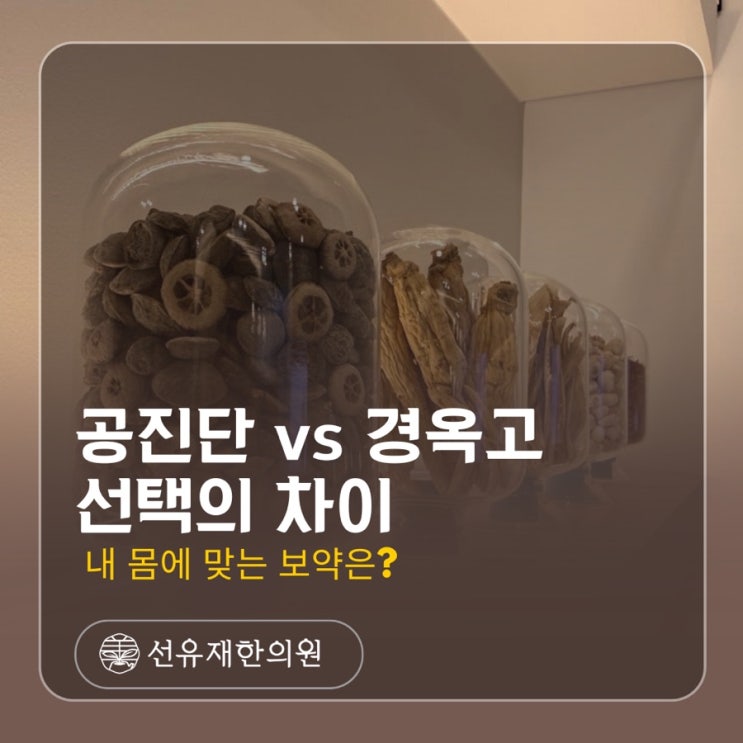
At Sunyujae Korean Medicine Clinic, we consider the pattern of fatigue and daily circumstances to determine the appropriate direction of restorative care, rather than simply choosing between Gyeongokgo and Gongjindan.
This issue of Monthly Sunyujae brings together Gyeongokgo’s historical background, its basic ingredients, ES Deer Antler Velvet Gyeongokgo, and its differences from Gongjindan.
You are welcome to browse Monthly Sunyujae at the clinic and revisit the information on our blog.
Related article: Features of ES Deer Antler Velvet Gyeongokgo
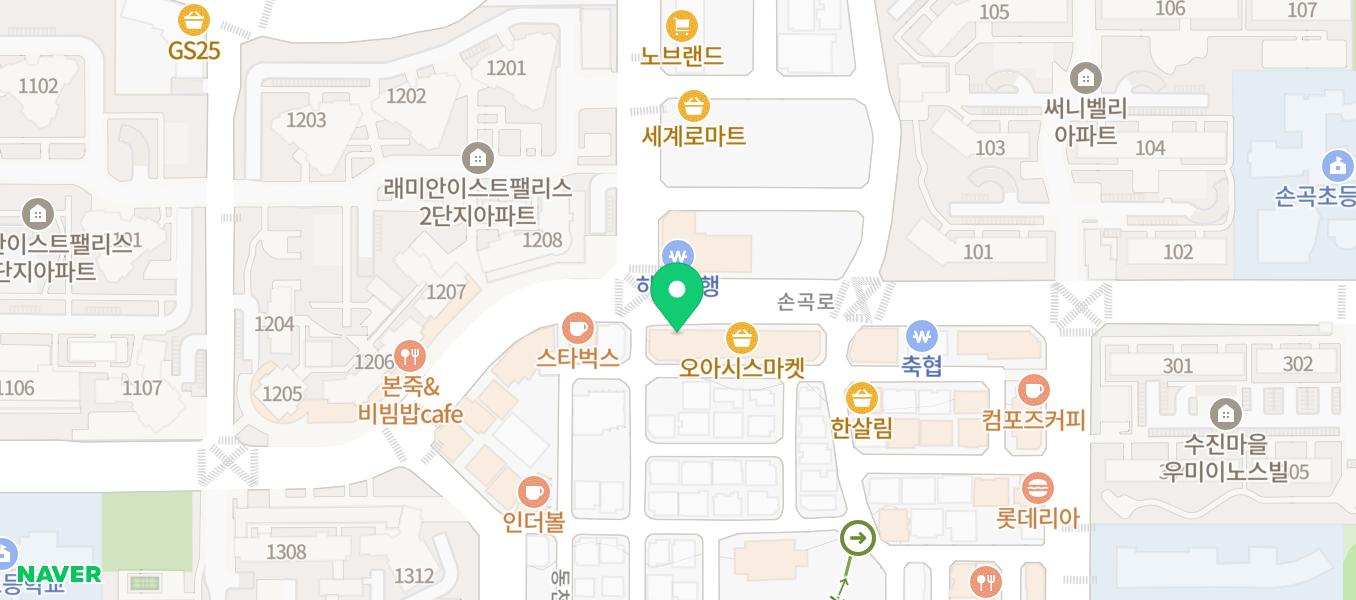
Sunyujae Korean Medicine Clinic in Suji-gu pursues evidence-based medicine and integrative medicine.
This post was written directly by the medical staff of Sunyujae Korean Medicine Clinic to provide medical information, in compliance with Article 56(2) and Article 57(3) of the Medical Service Act. The duration and outcome of treatment may vary from person to person, so please consult a qualified practitioner before beginning treatment.
Consultation & Booking
Have questions? Reach us anytime via KakaoTalk or phone.