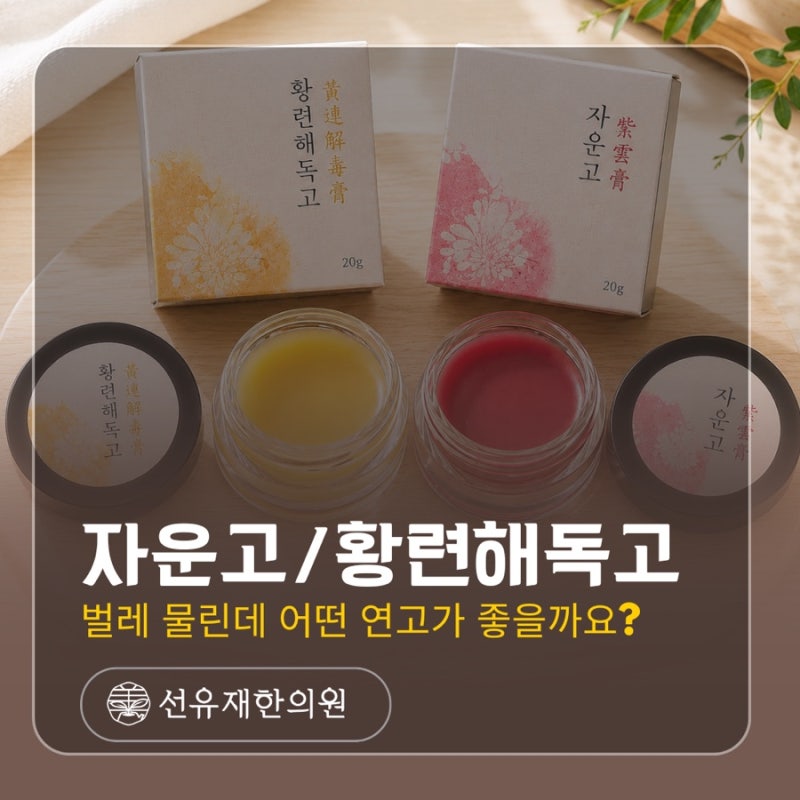
There are times when it’s confusing which ointment to apply for insect bites. At first, you might think it’s just a mosquito bite, but sometimes the itching lasts a long time, and red marks remain prominent. If you keep scratching, your skin can become sore and irritated, making you wonder if Jaungo is right, or Hwangnyeonhaedokgo. In the examination room at Sunyujae Korean Medicine Clinic in Dongcheon-dong, Suji-gu, we often hear questions like, “Can I apply Jaungo for insect bites?” or “When should Hwangnyeonhaedokgo be used?” Even if insect bite areas look similar on the surface, the skin condition can vary. Some people experience a strong red and hot sensation, while others find their skin rough and dry after scratching.
Therefore, when choosing an ointment for insect bites, it’s better to first assess your current skin condition rather than just the product name.
Skin Conditions to Check First After an Insect Bite
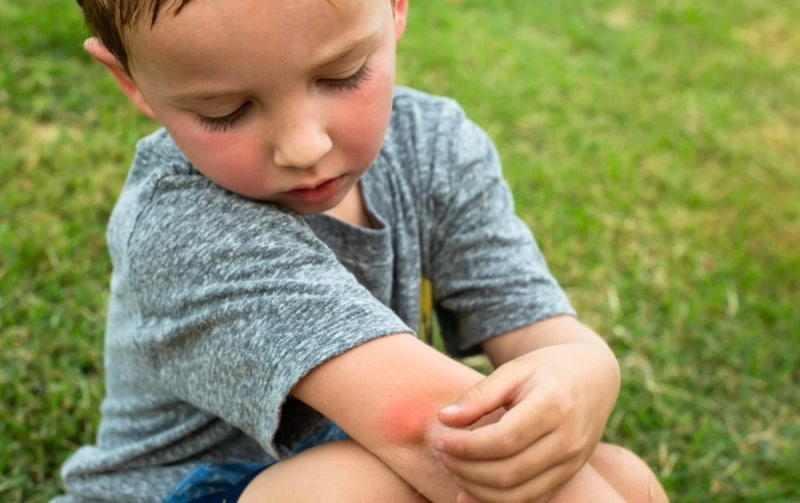
When bitten by an insect, the skin reacts to external stimuli. It’s common for it to itch, swell slightly, or turn red. The problem arises when you keep scratching due to the itch. Scratching with fingernails can strip the skin’s surface, create small wounds, cause oozing, or form scabs. Children often scratch unconsciously while sleeping, making insect bite marks appear larger the next day. Many people ask, “Can I apply just any ointment for mosquito bites?” However, the appropriate ointment can vary depending on whether it’s in a red and hot stage, or a dry and rough stage from scratching. When looking for an ointment for insect bites, it’s good to check three things first.
These are: if there’s strong redness, if there’s a sensation of heat, and if the skin has peeled from scratching. By looking at these three, you can more easily determine which of Jaungo or Hwangnyeonhaedokgo is more suitable.
Jaungo is Often Used for Dry and Rough Skin
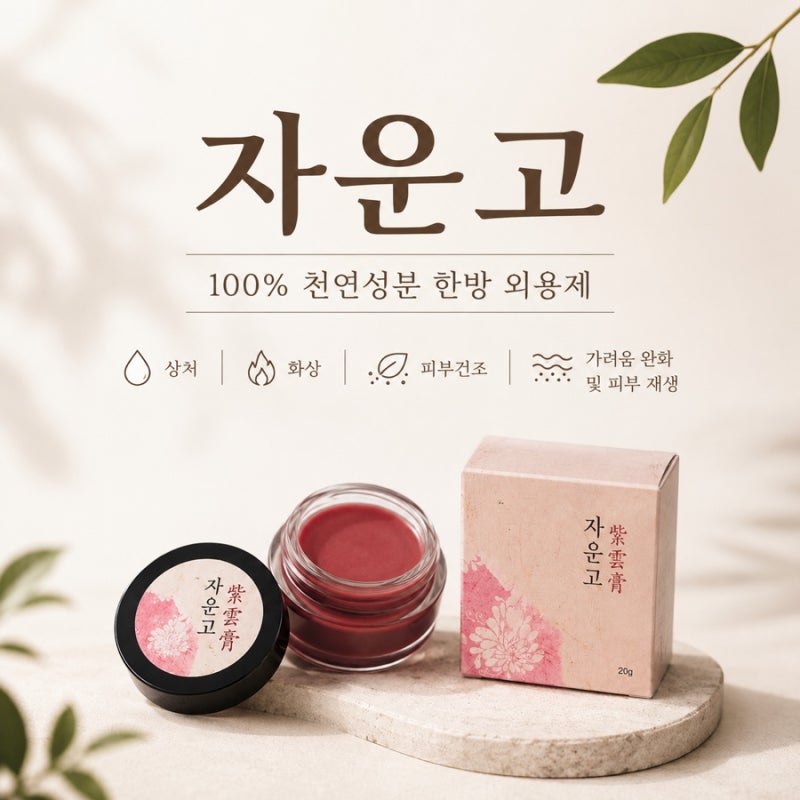
Jaungo is a Korean herbal topical preparation made with ingredients like Lithospermum root (Jacho), Angelica gigas (Dangui), sesame oil (Homayu), and beeswax (Millap). (Topical ointments are herbal ointments applied to the skin.) It is used to cover the surface of dry or cracked skin and to help reduce irritation to damaged skin. Those who seek Jaungo for insect bites usually say things like: “It was itchy at first, but after a few days, scabs formed, and the scratched area became rough.” Sometimes the skin feels tight and sore, or the area around the insect bite peels dryly. Jaungo’s indications are deeply related to dry and rough skin conditions.
It is often used for small wounds caused by scratching after an insect bite, skin that looks like dry eczema, minor abrasions, cracks, and a tight sensation after scabs have formed. Its oily texture gives a feeling of gently enveloping the skin. Therefore, it is more suitable not immediately after an insect bite when it is red and hot, but rather when the skin has become rough after scratching or when dryness remains during the recovery period. However, if there is a lot of oozing or severe heat sensation, continuously applying only Jaungo may not be appropriate. In such cases, it is necessary to first check if there is residual heat in the skin or if the wound has deepened.
Hwangnyeonhaedokgo is Often Sought When Skin is Red and Burning
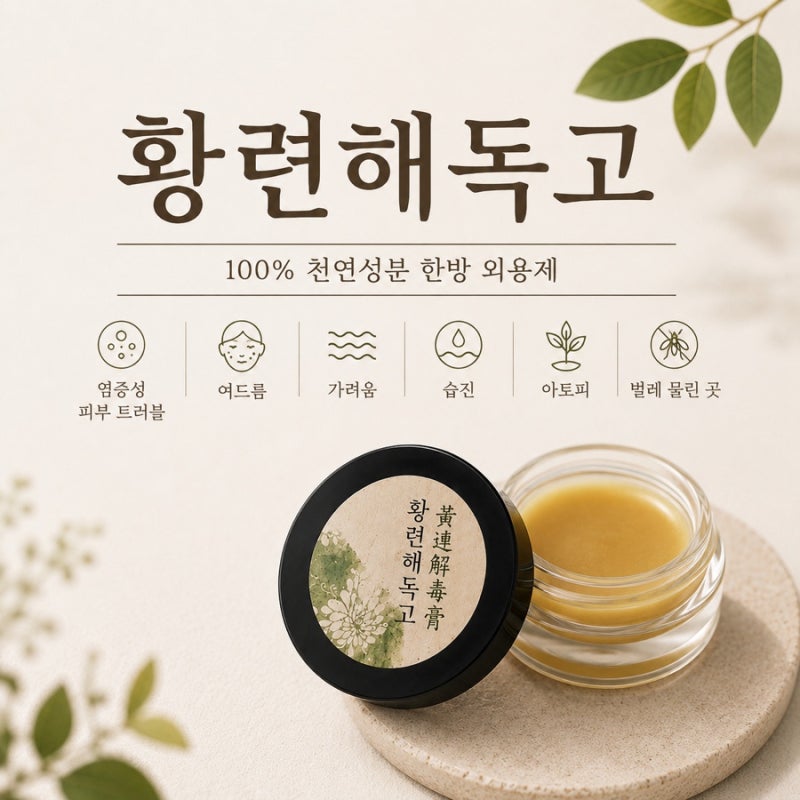
Hwangnyeonhaedokgo is a Korean herbal topical preparation made with ingredients like Coptis root (Hwangnyeon), Scutellaria root (Hwanggeum), Phellodendron bark (Hwangbaek), and Gardenia fruit (Chija). It is often used when the skin is red and inflamed, with both heat sensation and itching. Some people seek Hwangnyeonhaedokgo when a mosquito bite swells up unusually red, or when an insect bite feels hot and sore. We also consult patients when their skin feels sensitive even without scratching, or when they keep reaching for the area due to itching. Hwangnyeonhaedokgo’s indications are related to red irritation, heat sensation, itching, and a feeling of inflamed skin. It can be considered immediately after an insect bite when it’s swollen and burning, when it feels sore even without scratching, or when the skin is red and you keep wanting to touch it.
In situations like “My insect bite is so itchy,” “My mosquito bite is hot,” or “My child’s insect bite has turned red,” Hwangnyeonhaedokgo is often considered first. Conversely, if the skin is already significantly peeled or dry and cracked, more skin protection may be needed. Even for the same insect bite, one single ointment may not be suitable from start to finish.
The Difference Between Jaungo and Hwangnyeonhaedokgo is Easy to See This Way
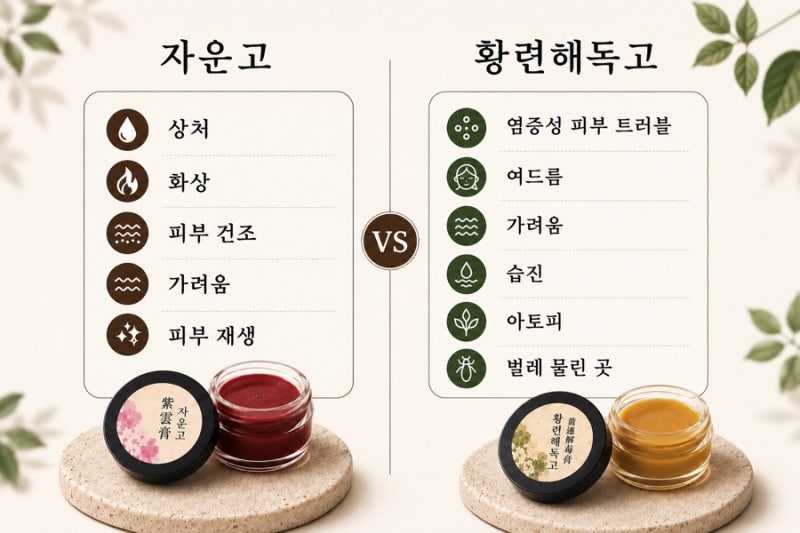
The difference between Jaungo and Hwangnyeonhaedokgo is easy to understand by considering “Is the skin dry, or hot?” Jaungo is well-suited for skin that has become rough and dry after scratching, areas that feel tight as scabs form, and conditions requiring skin protection. If an insect bite mark lingers and the surface becomes rough, Jaungo can be considered. Hwangnyeonhaedokgo is often used when the skin is red, burning, and intensely itchy. It may be more suitable immediately after an insect bite when it swells or when the skin feels as if it’s retaining heat. In the clinic, we explain it this way: for the red and hot stage, we consider Hwangnyeonhaedokgo first, and for the rough and dry stage caused by scratching, we consider Jaungo first.
However, actual skin conditions vary from person to person, so if symptoms persist or recur, it is safer to have them checked directly.
If you have wounds from scratching, ointment alone may not be enough. Continuously scratching an insect bite weakens the skin barrier. If bacteria enter, changes such as swelling, pain, oozing, or yellow scabs may occur. In such cases, rather than simply looking for “a good ointment for insect bites,” you need to assess the wound’s condition. Management can vary depending on whether there is only itching, suspected infection, or co-existing dermatitis. The same applies when looking for an ointment for a child’s insect bite. Children’s skin is thinner and can react more sensitively than adults’. Since scratches from fingernails are common, it’s necessary to keep nails trimmed short and maintain cleanliness of the bitten area.
Some people find that insect bite marks linger and leave dark pigmentation. In these cases, repeated scratching is often a greater cause than the bite mark itself. If you keep touching the area before the itching subsides, the skin has difficulty getting time to recover. How should you manage it at home? After an insect bite, first wash your hands and skin thoroughly. If sweat or dust remains, the itching can feel more severe. Instead of continuously scratching when itchy, placing a cold compress for a short time can help reduce irritation. It’s better to apply ointment thinly with clean hands or a cotton swab rather than thickly. If the skin is red and hot, reducing irritation is the priority.
If the skin is dry and rough, it’s necessary to protect it from scratching and manage it to prevent dryness. If an insect bite mark lingers, you keep scratching the same area, or swelling and heat sensation progressively worsen, it might not be just simple skin irritation. In such cases, rather than repeatedly changing ointments, it’s necessary to assess the current skin condition.

Q. Can I apply Jaungo right away to a mosquito bite?
Rather than when the skin is very red and hot, Jaungo is often more suitable for areas that have become dry and rough after scratching. If a scab is forming and the skin feels tight or rough, you can first look at its current condition.
Q. Is Hwangnyeonhaedokgo used right after an insect bite?
It is often used when the area is red, swollen, burning, and intensely itchy. However, if the wound is deep or there is a lot of oozing, it is safer to check the skin condition first.
Q. Can I apply Jaungo and Hwangnyeonhaedokgo together?
Rather than applying both to the same spot at once, it is better to choose one according to the skin’s condition. The red, hot stage and the dry, recovering stage can differ, so it varies with how the condition changes.
Q. Can it be used on a child’s insect bite?
A child’s skin can be sensitive, so apply a small, thin amount and watch for any reaction. If there is swelling, oozing, or pain, or if the child keeps scratching, it is safer to have it checked through a consultation.
Q. What should I do if an insect-bite mark lasts a long time?
Repeated scratching can leave lasting discoloration or thicken the skin. If the mark lingers and the itching keeps returning, it is worth checking whether dermatitis or secondary irritation is also present.
Q. If it stings more after applying the ointment, can I keep using it?
If the stinging does not pass quickly but keeps worsening, it is best to stop using it and check the skin’s condition. The skin may be broken or have become sensitive to irritation.
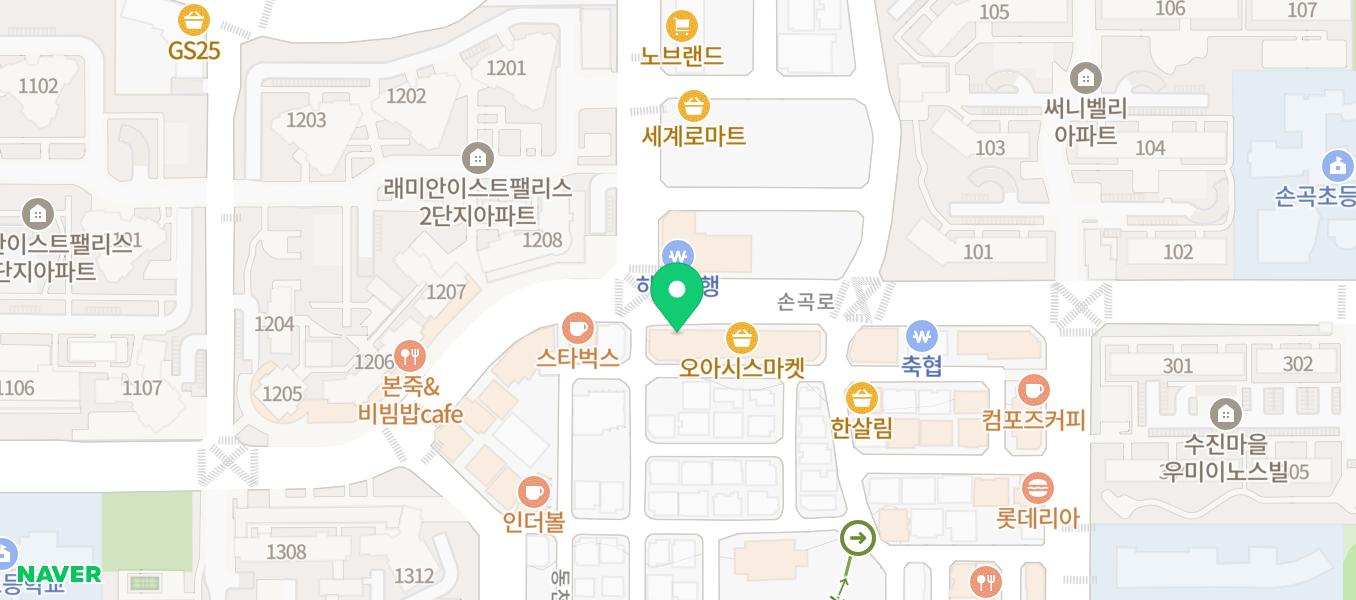
Which ointment is best for an insect bite depends on the skin’s current state. Depending on whether it is red and hot, or dry and rough from scratching, the choice between Jaungo and Hwangnyeonhaedokgo may differ. At Sunyujae Korean Medicine Clinic in Dongcheon-dong, Suji-gu, we examine long-lasting itching, red marks, and scratch-induced skin irritation after insect bites according to their current condition. Even if it looks like minor irritation, if it recurs or persists, it may be worth having your skin examined.
We hope you will join Sunyujae Korean Medicine Clinic in sharing valuable information for a healthy life.
This post was written directly by the medical staff of Sunyujae Korean Medicine Clinic to provide medical information, in compliance with Article 56(2) and Article 57(3) of the Medical Service Act. The duration and outcome of treatment may vary from person to person, so please consult a qualified practitioner before beginning treatment.
Consultation & Booking
Have questions? Reach us anytime via KakaoTalk or phone.