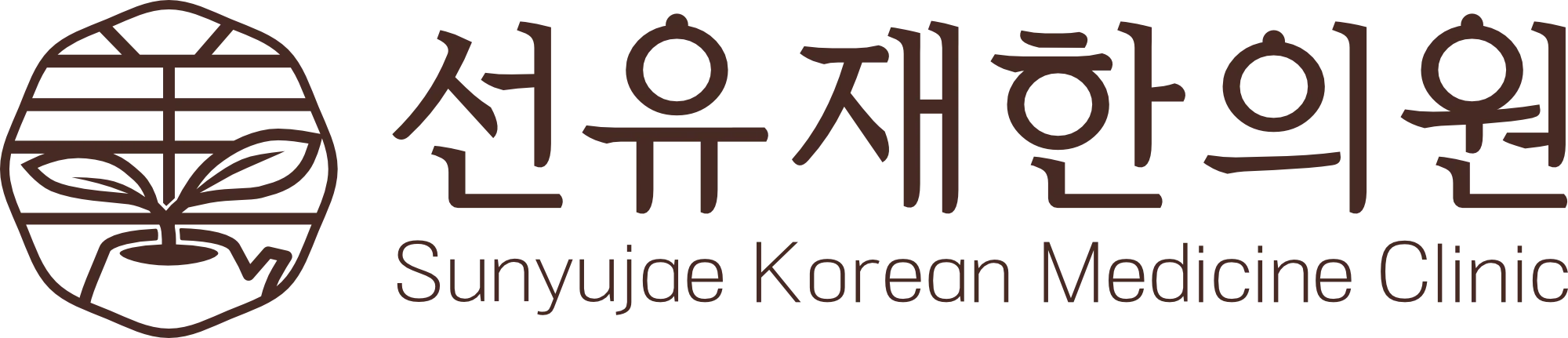
“When I try to twist a bottle cap and put force on my thumb, the area just above my wrist aches.”
“Every time I pick up napa cabbage, the base of my thumb throbs.”
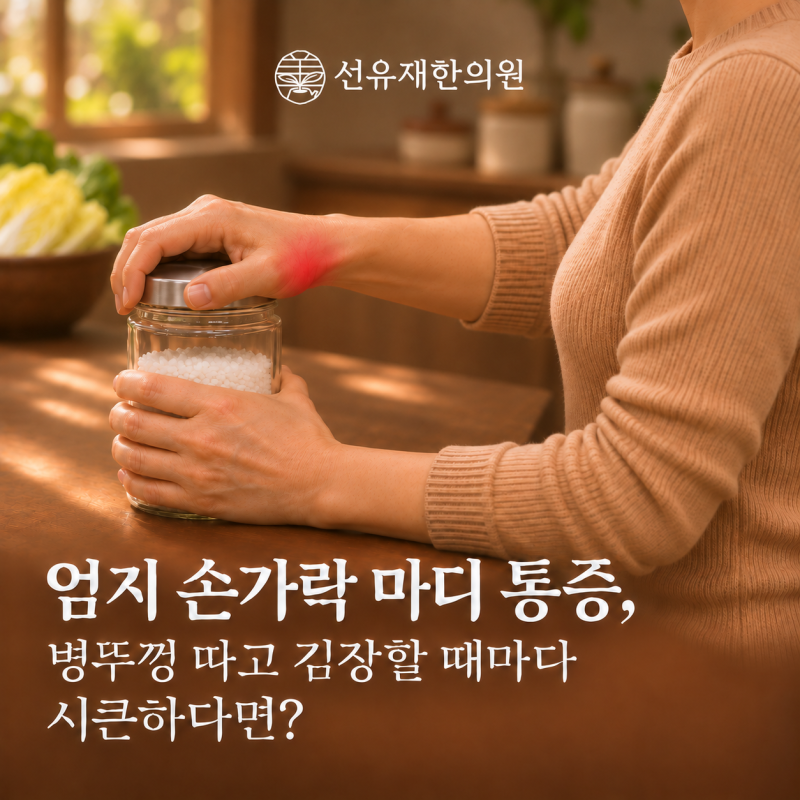
If you experience an aching sensation in your thumb joint, especially the thumb base joint just above your wrist, when twisting a bottle cap or picking up objects, it could be basal thumb arthritis. The thumb base joint is a saddle-shaped joint that allows the thumb to move in all directions. When gripping and twisting motions accumulate, the ligaments that support it can loosen, and the cartilage can wear down easily. A characteristic symptom is that pinching with the fingertips is more painful than grasping with the entire palm. During the kimjang season, when tasks like picking up and carrying napa cabbage or opening spice jar lids pile up, a thumb that was already slightly uncomfortable may be the first to give out.
Summary at a Glance
| Category | Description |
|---|---|
| What is it? | Basal thumb arthritis refers to a condition where the cartilage of the thumb base joint, located just above the wrist, wears down and the joint capsule swells. |
| Why does it occur? | It occurs when gripping and twisting motions accumulate, causing the ligaments supporting the joint to loosen, and the cartilage to wear down due to concentrated pressure on one side. |
| Sunyujae Korean Medicine Clinic Treatment | We examine the joint with musculoskeletal ultrasound while the thumb is in motion, and use Yanggeumhwa pharmacopuncture and acupotomy to aid recovery around the thumb base. |
What is basal thumb arthritis?
Basal thumb arthritis refers to osteoarthritis that develops in the thumb base joint, where the thumb meets the wrist bones. Unlike other fingers, the thumb has one less joint, but it has an additional saddle-shaped joint near the wrist. This joint allows the thumb to rotate freely forwards, backwards, left, and right, enabling it to touch other fingers.
To explain simply, it’s like a person sitting on a saddle who can lean their body forwards, backwards, and sideways.
While this joint allows for free movement, it relies heavily on the surrounding ligaments. Every time you pinch and twist with your fingertips, a much greater force is exerted on the thumb base than the force applied to the fingertips. As time passes and the ligaments loosen, the joint surfaces can become slightly misaligned. The cartilage then wears down quickly due to the concentrated pressure on one side, leading to an aching sensation at the thumb base with every pinching motion. It is more common in women, whose ligaments are relatively more flexible.
Thumb Joint Pain: Can We Differentiate Based on Where It Hurts?
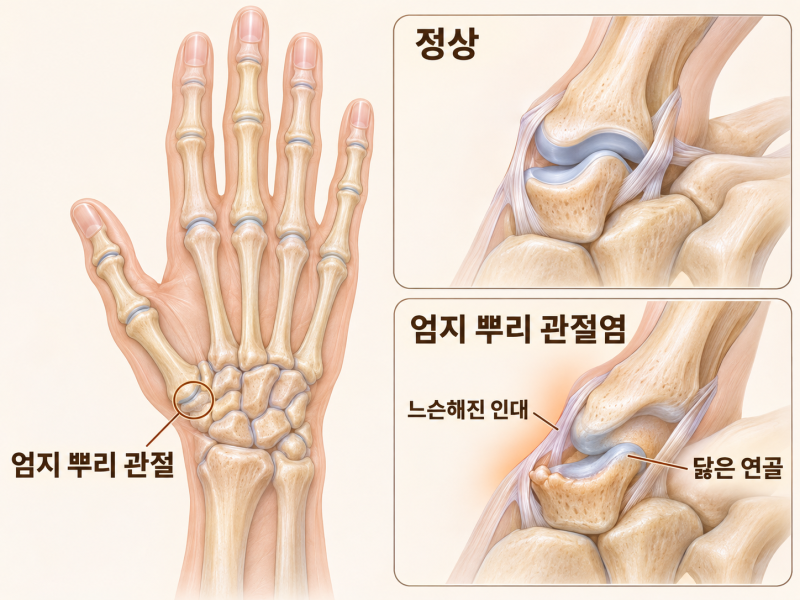
Thumb pain can suggest different conditions depending on the location of the pain. Initially, it may only hurt during pinching motions, but as it progresses, it can feel stiff even at rest, and the thumb base may appear to protrude angularly towards the wrist. With further progression, the space between the thumb and index finger may not open well, making it uncomfortable to hold a cup. In Korean medicine, this condition is viewed as the geun (筋, sinews) that support the heavily used joint becoming loose and fatigued.
Check which condition your symptoms are closer to
| Location of Pain | If it feels like this |
|---|---|
| Thumb base joint just above the wrist | Aching when pinching and twisting, base protrudes angularly — Basal thumb arthritis |
| Thumb side of the wrist | Sharp pain from wrist to forearm when extending and spreading the thumb — Suggests wrist tenosynovitis |
| Thumb base on the palm side | Catches when bending and extending, worse in the morning — Suggests tendon issue |
| Thumb tip joint | Joint below the fingernail becomes hard and thick — Suggests tip joint issue |
How does Sunyujae Korean Medicine Clinic treat basal thumb arthritis?
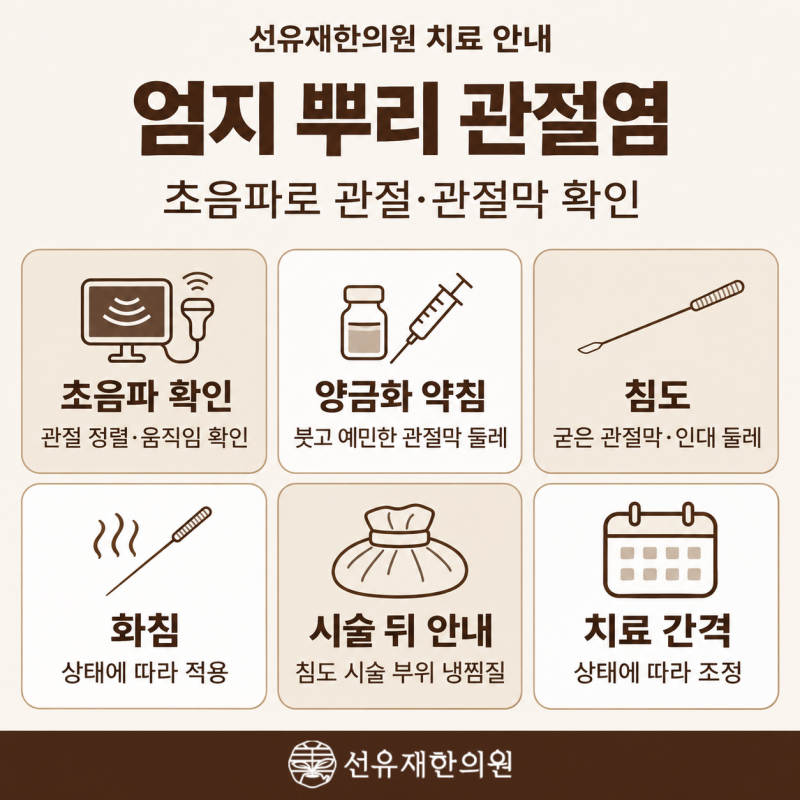
At Sunyujae Korean Medicine Clinic, for basal thumb arthritis, we first use musculoskeletal ultrasound to check the degree of joint misalignment and joint capsule swelling, then use Yanggeumhwa pharmacopuncture and acupotomy to aid recovery around the thumb base. I first ask which motions you use your thumb for most often, and whether it hurts more when pinching or grasping. By palpating the thumb base with my fingers, I differentiate whether the aching spot is the joint or the tendon on the side of the wrist. For the ultrasound, we position the hand sideways with the thumb pointing upwards, supported by a towel under the wrist. On the screen, I examine how much the joint surfaces are misaligned, whether the joint capsule is swollen, and if there are any bone spurs at the joint’s edge. Next, I ask you to slowly perform a pinching motion with your thumb and index finger, and we observe together how the joint shifts during movement. Patients can also view the appearance of their thumb base joint on the screen.
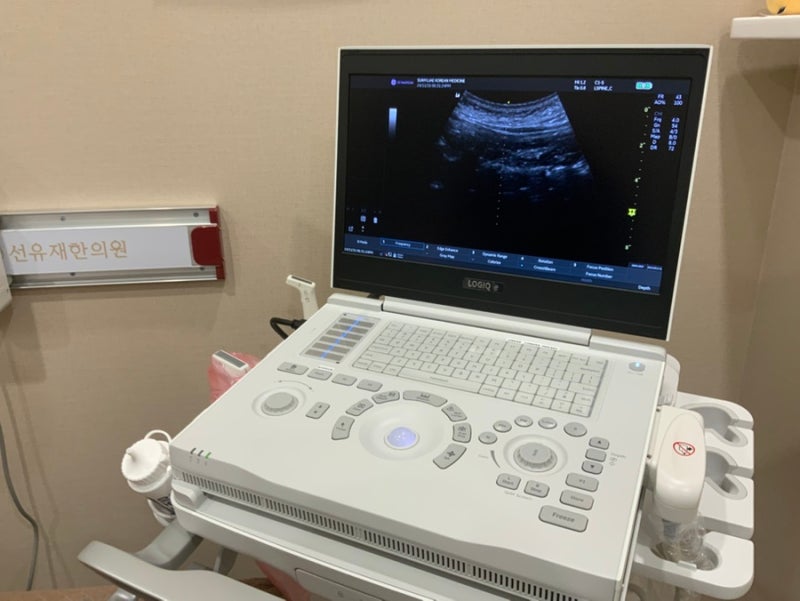
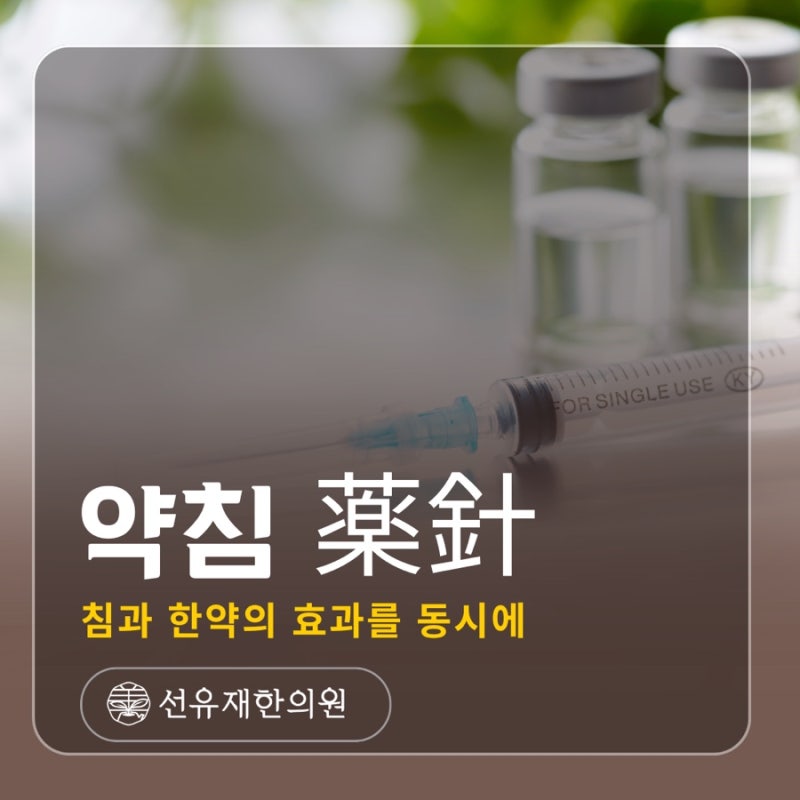
If the joint capsule is swollen and sensitive, pharmacopuncture is the primary focus. We use Yanggeumhwa pharmacopuncture, which is used for musculoskeletal inflammatory pain, by observing the joint capsule’s position on the screen and administering it around the thumb base to help calm sensitive tissues and promote recovery.
If the swelling has subsided but the joint capsule and surrounding ligaments are thickened and stiff, making it difficult to spread the thumb, we consider acupotomy. Using a thin acupotomy needle with a flat tip, we release the stiff and adhered tissues to help improve the thumb’s spreading motion. Fine nerves and blood vessels that go to the back of the hand pass by the thumb base, so we confirm their location on the screen during the procedure. If the thumb base is stiff due to cold, we may also use fire needle (heated acupuncture) depending on the condition.
During the swollen and sensitive phase, we typically administer pharmacopuncture about 3 times a week. For chronic stiffness, treatment continues for about 3-4 weeks, 1-2 times a week. For acupotomy, we will guide you on the interval after checking your condition, and please apply a cold compress to the treated area on the day of the procedure. Treatment direction and duration may vary depending on your condition.
Kimjang and Bottle Caps: How to Reduce Strain on Your Thumb Base
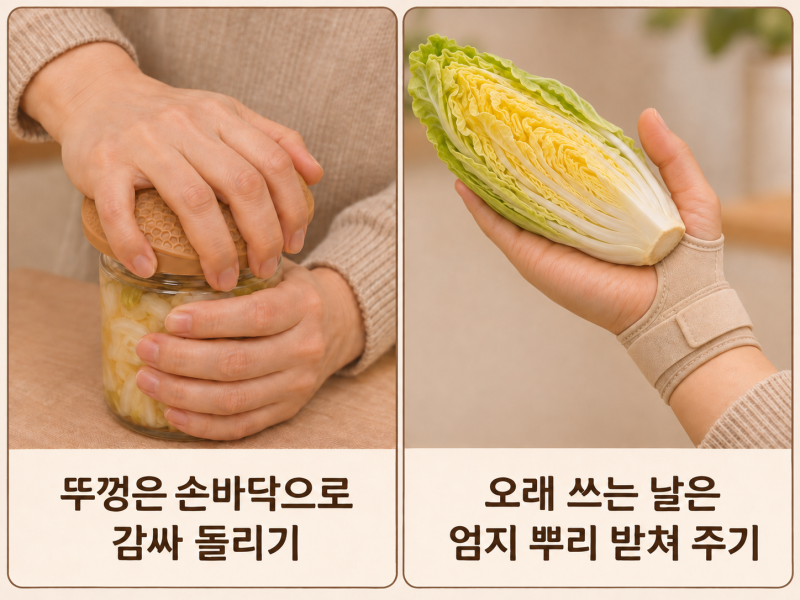
When handling napa cabbage or radishes, avoid pinching with your fingertips; instead, support them with your entire palm and lift with both hands. For bottle caps, using a rubber pad and twisting with your palm wrapped around it can reduce the force exerted on your thumb base. On days when you use your thumb extensively, such as during kimjang, a brace that supports the thumb base can be helpful.
Frequently Asked Questions
Q. If I have thumb joint pain, should I avoid using my thumb? If you completely immobilize your thumb, the joint can stiffen more easily. Reduce only tight pinching and twisting motions with your fingertips, and move your thumb gently within a pain-free range.
Q. My thumb base protrudes; can it go back in? It is difficult to reverse a shape that has already become misaligned and settled. However, treatment and management can continue with the goal of reducing swelling and pain at the thumb base, and making pinching motions more comfortable. If your thumb base suddenly becomes red, swollen, and hot, or if the tips of your thumb and index finger feel numb, please have your condition checked during a consultation first.
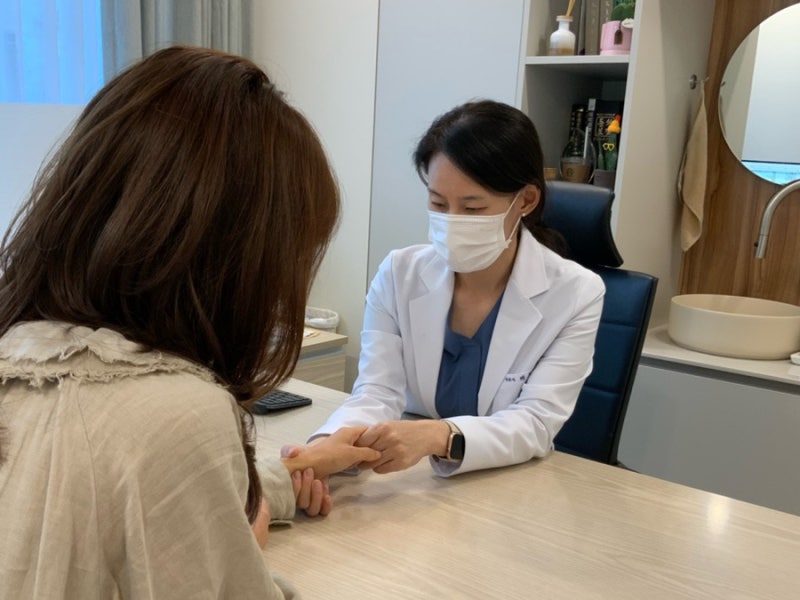
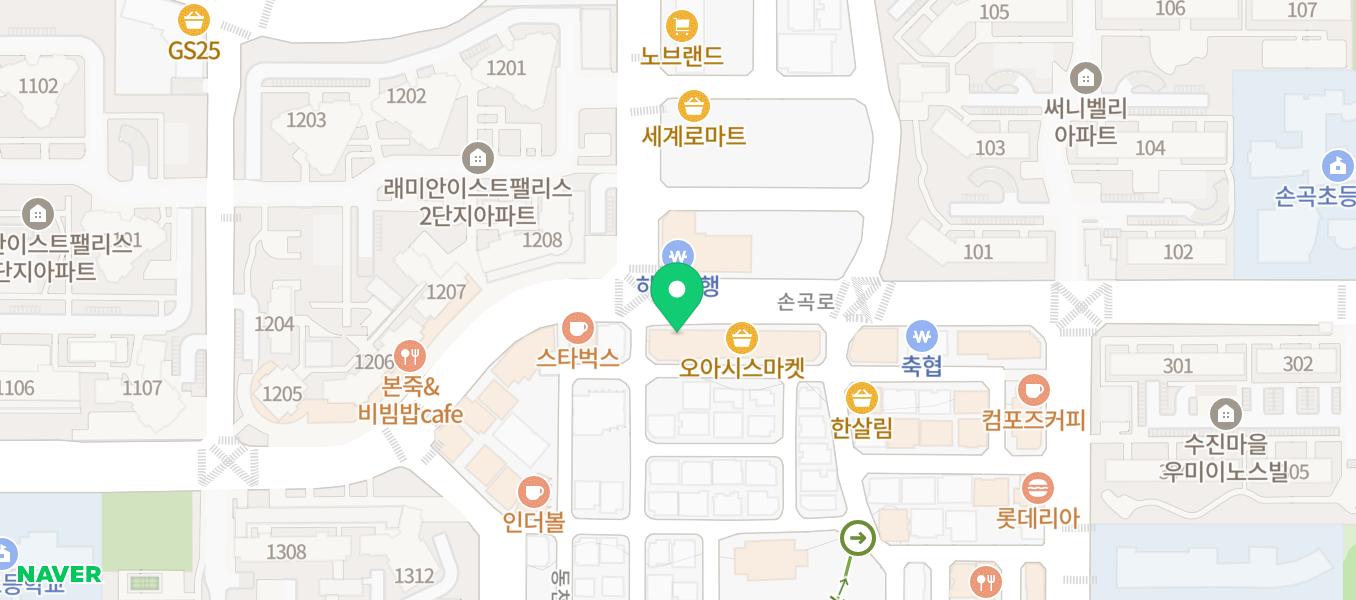
Thumb joint pain often occurs when the ligaments supporting the thumb base joint loosen and the cartilage wears down. Since tasks like kimjang and opening bottle caps are difficult without your thumb, you’ve likely endured the aching and continued to use it. I examine the thumb base joint with musculoskeletal ultrasound while the thumb is in motion, and use Yanggeumhwa pharmacopuncture and acupotomy to aid recovery. If you are in the Dongcheon-dong, Suji-gu area and the base of your thumb aches every time you pinch, start by having the joint checked.
Where a Kind Heart Resides, Sunyujae Korean Medicine Clinic
Sunyujae Korean Medicine Clinic in Suji-gu pursues evidence-based medicine and integrative medicine.
This post was written directly by the medical staff of Sunyujae Korean Medicine Clinic to provide medical information, in compliance with Article 56(2) and Article 57(3) of the Medical Service Act. The duration and outcome of treatment may vary from person to person, so please consult a qualified practitioner before beginning treatment.
Consultation & Booking
Have questions? Reach us anytime via KakaoTalk or phone.