
Many patients who visit our clinic in Suji-gu seeking treatment for frozen shoulder often say, “My shoulder doesn’t go up,” “I can’t move my arm behind my back,” or “Shoulder pain at night keeps me from sleeping.” It’s not common for the shoulder to become severely stiff from the beginning. Initially, there’s a slight discomfort when lifting the arm, then at some point, washing hair becomes difficult, and moving the arm behind the back when changing clothes becomes hard.
We often hear these questions in the examination room: “Is it true that frozen shoulder gets better on its own over time?” “I thought it would get better if I just endured it, but it’s getting harder to lift my arm.” “I don’t know if I should exercise or rest.” To put it simply, while some cases of frozen shoulder do improve over time, not everyone recovers naturally.
Especially if shoulder pain persists for a long time, and there are clear limitations in movement, such as not being able to lift your arm or move it behind your back, it’s better to check what changes are occurring inside the shoulder rather than just waiting. Today, we will explain why frozen shoulder occurs, why the arm feels stiffer over time, and how Sunyujae Korean Medicine Clinic in Suji-gu approaches frozen shoulder treatment. Hello, this is Sunyujae Korean Medicine Clinic, a place where kind hearts reside.

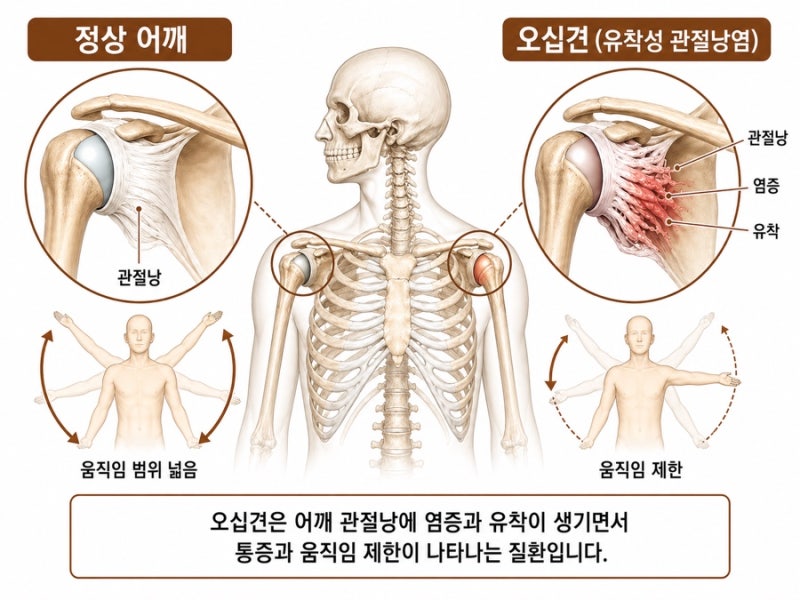
Cause of Frozen Shoulder: The Process of Shoulder Joint Capsule Stiffening. What is the joint capsule? Many people think of frozen shoulder as simply a condition where the shoulder stiffens.
Of course, the visible symptom is difficulty lifting the arm. However, looking inside, it’s a bit more complex. The shoulder joint is surrounded by a thin sac called the joint capsule.
This joint capsule naturally stretches and folds when you move your arm, helping the shoulder move smoothly. However, if an inflammatory reaction occurs in this area, and over time the joint capsule thickens or stiffens, the space for arm movement decreases. Simply put, it’s similar to a comfortable piece of clothing suddenly becoming too small.
The body tries to move, but the internal space of the shoulder cannot accommodate it, causing a pulling sensation, pain, and inability to move the arm beyond a certain angle when lifting it. Therefore, it is more accurate to understand frozen shoulder not as simple muscle pain, but as a condition characterized by inflammation inside the shoulder joint, stiffness of the joint capsule, adhesions, and restricted movement.
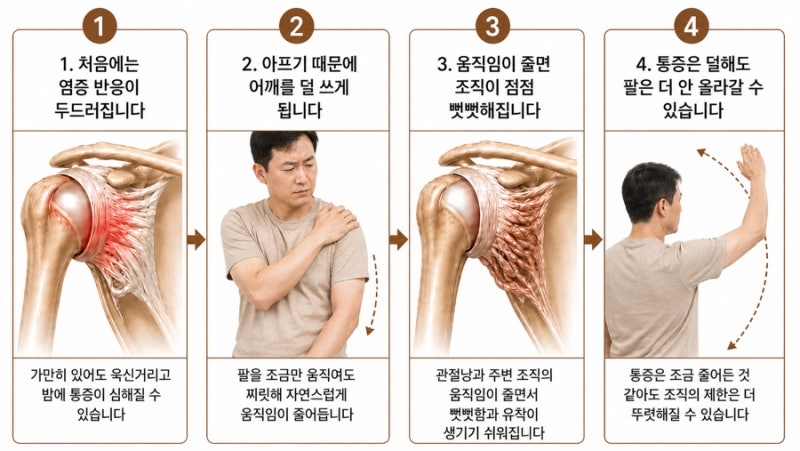
Frozen Shoulder Symptoms: Why Does It Hurt First and Then Stiffen? Reasons Why Frozen Shoulder Worsens. Frozen shoulder manifests differently in each person, but generally, pain and restricted movement often progress together. Initially, inflammatory reactions are prominent.
During this period, there’s a throbbing pain even at rest, and some people experience severe night pain that disrupts their sleep. Even a slight wrong movement of the arm causes a sharp pain, leading people to naturally use their shoulder less. The problem starts here.
If the shoulder is used less due to pain, the movement of the joint capsule and surrounding tissues decreases. Tissues with reduced movement gradually become stiffer, and if this state is repeated, adhesions are likely to form. Adhesions, simply put, are a state where tissues cannot slide smoothly and stick to each other.
When this happens, the pain might feel slightly reduced, but there can be a sensation that the arm won’t lift any further. This is why patients often say: “It hurt at first, but now it just doesn’t move.” This statement well encapsulates the progression of frozen shoulder. When treating frozen shoulder patients in Suji-gu, we often find that they visit our clinic more due to the “frustration of not being able to lift their arm” than the pain itself.
At this point, it’s not enough to just look at the painful area; we must also check which direction the shoulder is stiff, and the condition of the joint capsule, surrounding tendons, and muscles.
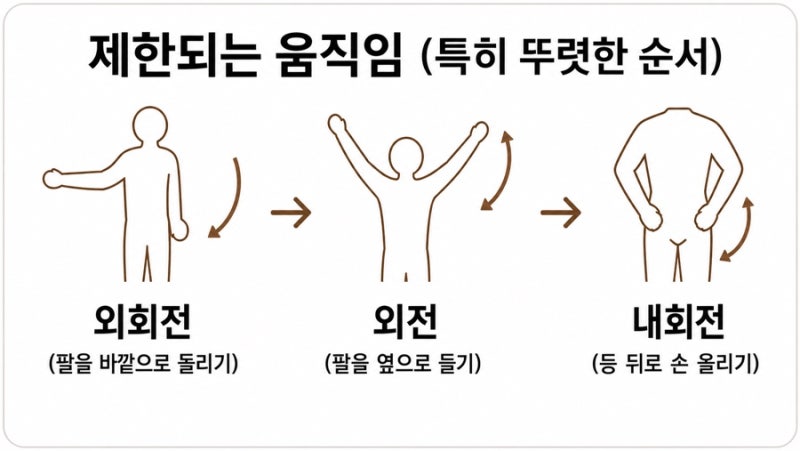
I can’t move my arm behind my back: A common daily inconvenience with frozen shoulder. Reasons for Daily Inconvenience Due to Frozen Shoulder. One of the most difficult movements for people with frozen shoulder is rotating the arm backward. For example, women say it’s difficult to fasten a bra hook, and men say it’s hard to put their hand in their back pocket.
This movement isn’t just about moving the arm backward. It requires the shoulder joint to rotate internally, the scapula to move along, and the surrounding tissues of the chest and back to follow smoothly. However, with frozen shoulder, the lower and anterior parts of the joint capsule often become particularly stiff.
This results in significant restriction when rotating the arm backward. Therefore, when assessing frozen shoulder, it’s not enough to just look at the arm lifting motion; we must also check movements like rotating backward, abducting sideways, and externally rotating. This is because the shoulder is not a joint that moves in only one direction.
At Sunyujae Korean Medicine Clinic, when treating frozen shoulder, we don’t just look at whether the “arm can be lifted.” We also check at what angle pain occurs, where the arm gets stuck when rotating backward, and whether the movements of the neck, back, and scapula are also compromised.
Why Frozen Shoulder Can Lead to Stiffness in the Neck and Back Over Time. The reason for stiffness extending to the neck and back is compensatory movement. Many frozen shoulder patients report not only shoulder pain but also stiffness in their neck and back. The reason is compensatory movement. If the shoulder doesn’t move well, our body tries to compensate for the lack of movement by using other areas.
When lifting the arm, if the shoulder joint cannot move sufficiently, people tend to shrug their neck, arch their back, or excessively move their shoulder blades. Initially, this might seem harmless, but if these movements are repeated, the neck and back muscles remain constantly tense. Therefore, those with chronic frozen shoulder sometimes complain of not only shoulder pain but also neck stiffness, back stiffness, and arm heaviness.
In such cases, rather than just intensely loosening the shoulder, it’s important to also consider scapular movement and tension around the neck and back. Especially when frozen shoulder has been prolonged, not only the tissues around the shoulder stiffen, but also the muscles of the neck, back, and front of the chest can become stiff, leading to more complex movement restrictions.
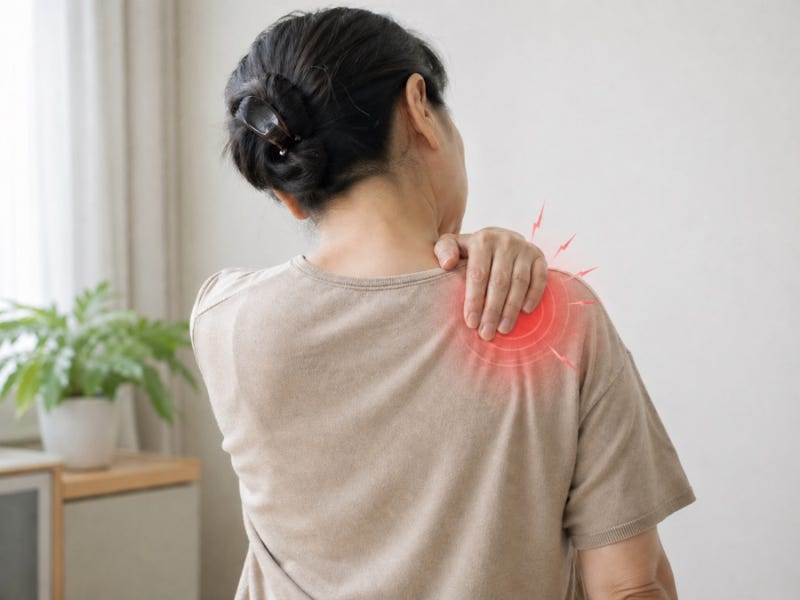
Timing is crucial for frozen shoulder stretching exercises. Timing is crucial for frozen shoulder stretching exercises. Many people hear that they should exercise if they have frozen shoulder. While this is true, the timing and method are important.
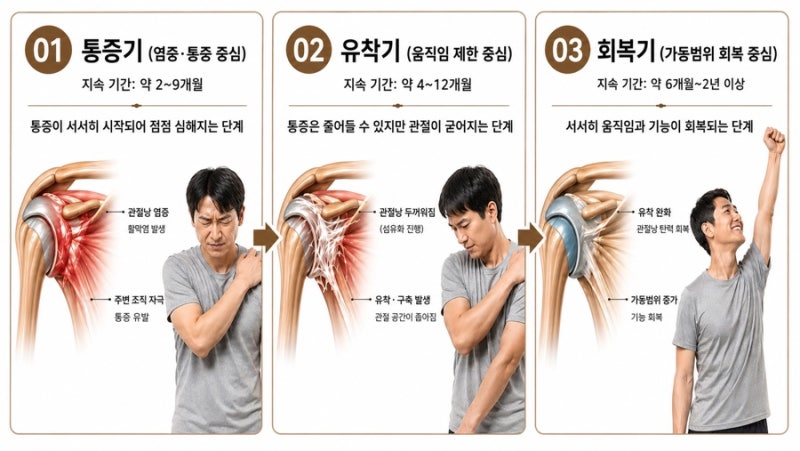
Frozen shoulder can broadly be divided into three phases based on its progression: the painful phase, the freezing phase (adhesive phase), and the thawing phase (recovery phase). In the initial painful phase, inflammatory reactions are prominent in the shoulder joint capsule and surrounding tissues, often causing throbbing pain even at rest, or severe night pain. If you forcefully bend your arm or intensely stretch while enduring pain during this period, the inflammatory reaction can become even more sensitive.
Especially if night pain is severe and there’s a throbbing sensation even at rest, a process to stabilize the pain and inflammatory reaction may be necessary first. Later, as it progresses to the freezing phase (adhesive phase), the pain might feel slightly reduced, but the joint capsule thickens and surrounding tissues stiffen, gradually restricting arm movement. Patients often say, “The pain is a bit less now, but my arm won’t lift,” during this stage.
Conversely, if the pain has decreased but the arm is stiff and won’t lift, an approach to gradually restore movement in the joint capsule and surrounding tissues is important. In the final thawing phase (recovery phase), pain and restricted movement gradually ease, and shoulder range of motion and function slowly recover. However, the time it takes for recovery varies from person to person, and can differ depending on the initial degree of inflammation, joint capsule adhesions, rotator cuff condition, and shoulder usage habits.
In other words, frozen shoulder exercises are not about doing as much as possible; they should be tailored to which stage your shoulder is in. Exercising while enduring pain is not treatment and can make the shoulder more defensive. Whether it’s a period of sensitive pain, a period of significant movement restriction due to a stiff joint capsule, or if there’s accompanying inflammation around the rotator cuff or tendons, the exercise intensity and treatment direction should vary.
Frozen Shoulder Treatment: Finding the Stiffened Location is Key. When discussing acupotomy treatment for frozen shoulder, the most important criterion is where the movement restriction is originating. Frozen shoulder is not merely a painful shoulder condition, but a condition where the joint capsule and surrounding soft tissues stiffen, and movement around tendons and ligaments decreases, causing the shoulder to gradually freeze.
In such cases, a distinct feeling of being blocked can occur at a certain point when lifting the arm upwards, sideways, or reaching behind the back. The goal of treatment is not merely to reduce pain, but to create an environment where the shoulder can move smoothly again. Acupotomy Treatment: Directly Treating Stiffened Joint Capsule and Adhesions. Unlike general acupuncture, acupotomy uses a needle with a micro-blade tip, allowing for direct treatment of stiff soft tissues, suspected adhesions,
and areas where tension has strongly accumulated, by directly releasing them. However, what’s important is not to stimulate forcefully without discretion. The shoulder is a complex joint where the joint capsule, rotator cuff, biceps tendon, bursa, ligaments, and scapular movements are all interconnected.
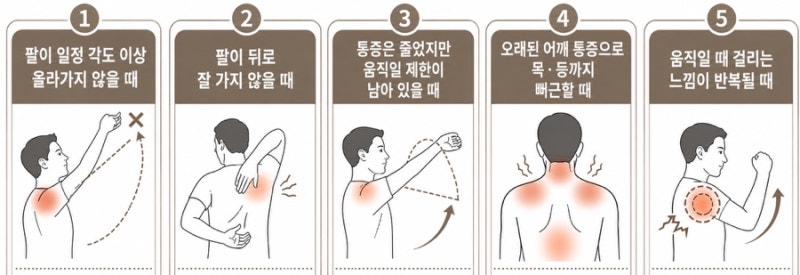
Therefore, it is crucial to identify which tissues are stiff and which directions of movement are restricted, then approach with the necessary depth and direction. In these cases, acupotomy for frozen shoulder can be considered. Simple massage or stretching alone may have limitations in the following situations: – If the arm does not lift beyond a certain angle, – If the arm does not move well behind the back, – If pain has decreased but movement restriction remains,
– If chronic shoulder pain causes stiffness in the neck and back, – If a catching sensation repeatedly occurs when moving the shoulder.
However, acupotomy for frozen shoulder is not necessarily required for everyone. During periods of highly sensitive inflammation, treatment to stabilize the pain response may be prioritized, while during periods when tissues are stiff and movement restriction is clear, a more proactive approach, including acupotomy, may be necessary. Therefore, before starting frozen shoulder treatment at Sunyujae Korean Medicine Clinic in Suji-gu, we first assess the pain pattern, direction of movement restriction, presence of night pain, the angle to which the arm can be lifted, and the range of backward rotation.
If necessary, we use high-resolution ultrasound to examine the rotator cuff, condition around the tendons, bursa, and periarticular tissues, and then determine if acupotomy is required. Frozen shoulder can sometimes improve over time. However, if the pain persists for a long time, arm movement is severely restricted, or daily life is significantly inconvenienced, simply waiting may not be the answer.
Especially if daily repetitive movements like washing hair, dressing, driving, or sleeping are uncomfortable, it’s advisable to check the internal structures of the shoulder. What’s important is not just “whether it’s frozen shoulder or not.” It’s more crucial to determine whether your shoulder is currently in a highly painful phase, a stiffening phase, or if there are accompanying conditions like rotator cuff issues or other shoulder disorders.
At Sunyujae Korean Medicine Clinic in Suji-gu, we do not view frozen shoulder as merely simple shoulder pain, but also examine the movement of the shoulder joint, restrictions of the joint capsule, condition around the tendons, and compensatory tension extending to the neck and back. If necessary, we create a personalized treatment plan using acupuncture, pharmacopuncture, and acupotomy to help alleviate pain and restore shoulder movement.
If your shoulder is progressively stiffening, we recommend accurately assessing your current condition rather than just enduring it. This was Dr. Hyocheong Chae from Sunyujae Korean Medicine Clinic in Suji-gu.
We hope you will join Sunyujae Korean Medicine Clinic, which shares valuable information for a healthy life. Sunyujae Korean Medicine Clinic in Suji-gu pursues evidence-based medicine and integrative medicine.
This post was written directly by the medical staff of Sunyujae Korean Medicine Clinic to provide medical information, in compliance with Article 56(2) and Article 57(3) of the Medical Service Act. The duration and outcome of treatment may vary from person to person, so please consult a qualified practitioner before beginning treatment.
Consultation & Booking
Have questions? Reach us anytime via KakaoTalk or phone.