
![[수지구 선유재한의원] 교통사고 후유증, 왜 시간이 지나서 나타날까요?](https://syjkmc.kr/wp-content/uploads/2026/06/224283478255_img_0.jpeg)
Hello, this is Sunyujae Korean Medicine Clinic, a place where kind hearts reside.

Many people ask, “My car wasn’t badly damaged, so why am I in so much pain?” The intensity of pain is not proportional to the severity of the accident. This is due to the body’s startled, tense, and unconsciously stiffening reflex spasm.
In particular, those who frequently experienced stiff necks and shoulders, or had herniated discs or military neck, often suffer from prolonged pain even after minor fender benders. Furthermore, even after being told “no abnormalities” on X-ray or MRI scans, the body can still feel stiff, heavy, and easily accumulate fatigue. This is because invisible soft tissue damage and circulatory stagnation persist.
Therefore, early intervention is crucial for post-traffic accident sequelae. To prevent pain from becoming chronic, it’s essential to harness the body’s healing power, timely relax tense muscles and ligaments, and resolve circulatory blockages. Post-traffic accident sequelae: An invisible impact that lasts longer!
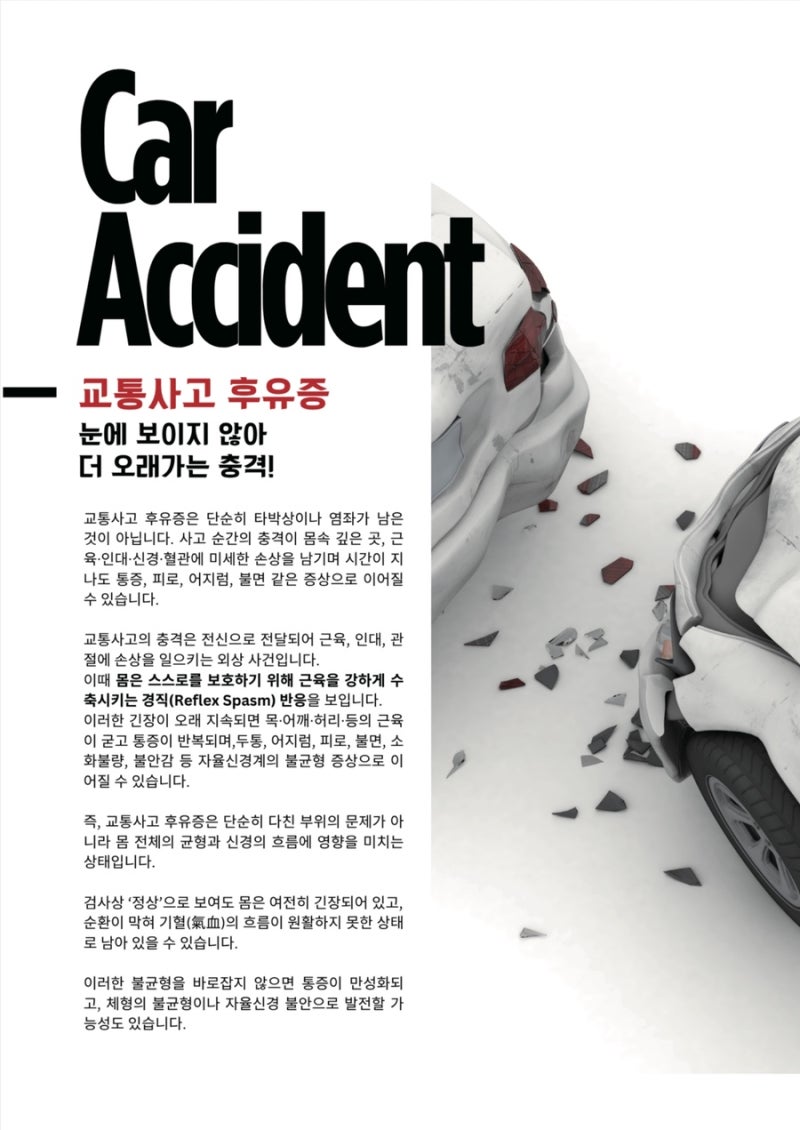
Post-traffic accident sequelae are not merely residual bruises or sprains. The impact of the accident can leave microscopic damage deep within the body’s muscles, ligaments, nerves, and blood vessels, leading to symptoms like pain, fatigue, dizziness, and insomnia even over time. The impact of a traffic accident is a traumatic event that transmits throughout the entire body, causing damage to muscles, ligaments, and joints.
At this time, the body exhibits a reflex spasm, strongly contracting muscles to protect itself. If this tension persists for a long time, muscles in the neck, shoulders, lower back, and back can stiffen, leading to recurring pain, and symptoms of autonomic nervous system imbalance such as headaches, dizziness, fatigue, insomnia, indigestion, and anxiety.
In other words, post-traffic accident sequelae are not merely problems in the injured area, but a condition that affects the overall balance of the body and the flow of nerves. Even if examinations show ‘normal’ results, the body may still remain tense, with circulation blocked and the flow of Qi and blood (氣血) not smooth. If this imbalance is not corrected, pain can become chronic, and there is a possibility of developing postural imbalances or autonomic nervous system instability.
Post-traffic accident sequelae! The intensity of pain differs from the severity of the accident. Post-traffic accident sequelae are not necessarily proportional to the magnitude of the collision.
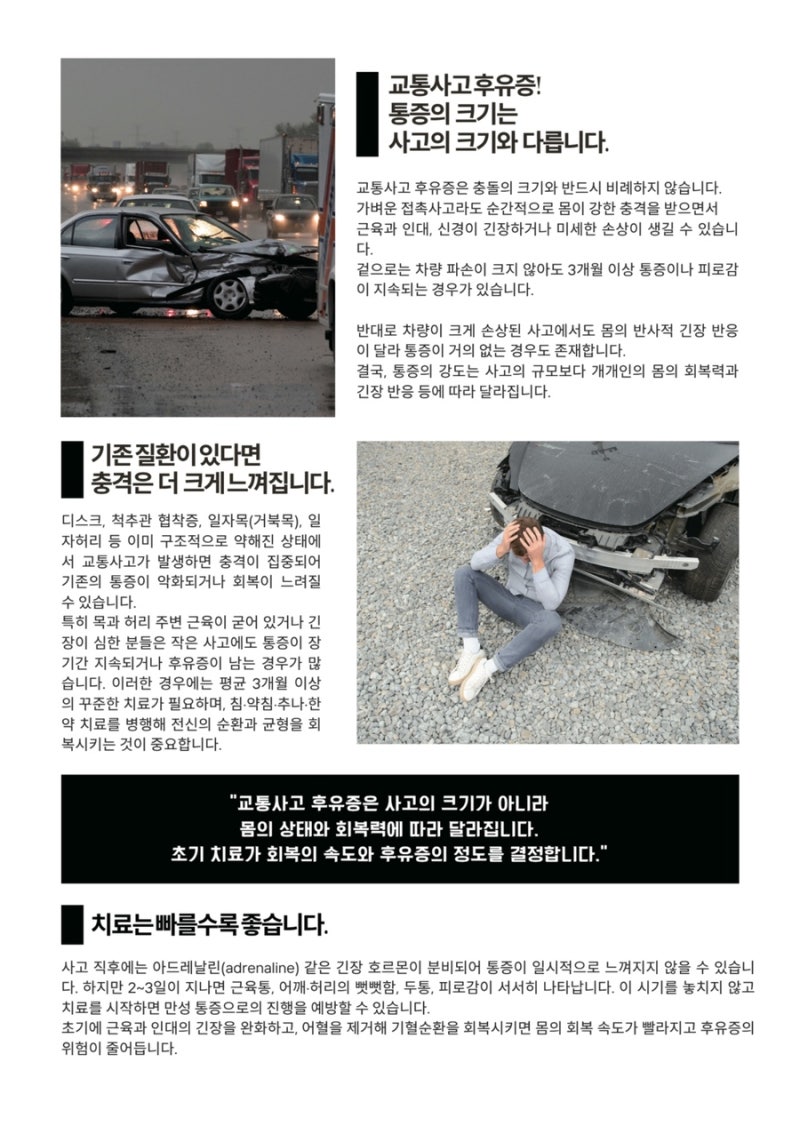
Even a minor fender bender can cause the body to experience a strong impact instantaneously, leading to tension or microscopic damage in muscles, ligaments, and nerves. Even if there is no significant visible damage to the vehicle, pain or fatigue can persist for more than three months. Conversely, there are cases where even in accidents with significant vehicle damage, the body’s reflex tension response differs, resulting in little to no pain.
Ultimately, the intensity of pain varies depending on an individual’s body’s recovery ability and tension response, rather than the scale of the accident. If pre-existing conditions are present, the impact is felt more severely. If a traffic accident occurs when the body is already structurally weakened by conditions such as herniated discs, spinal stenosis, military neck (text neck), or flat back, the impact can be concentrated, worsening existing pain or slowing recovery.
In particular, those with stiff or severely tense muscles around the neck and lower back often experience prolonged pain or lingering sequelae even after minor accidents. In such cases, consistent Korean medicine treatment for an average of three months or more is necessary, and it is important to combine acupotomy, pharmacopuncture, Chuna manual therapy, and herbal medicine treatment to restore overall circulation and balance. The sooner the treatment, the better.
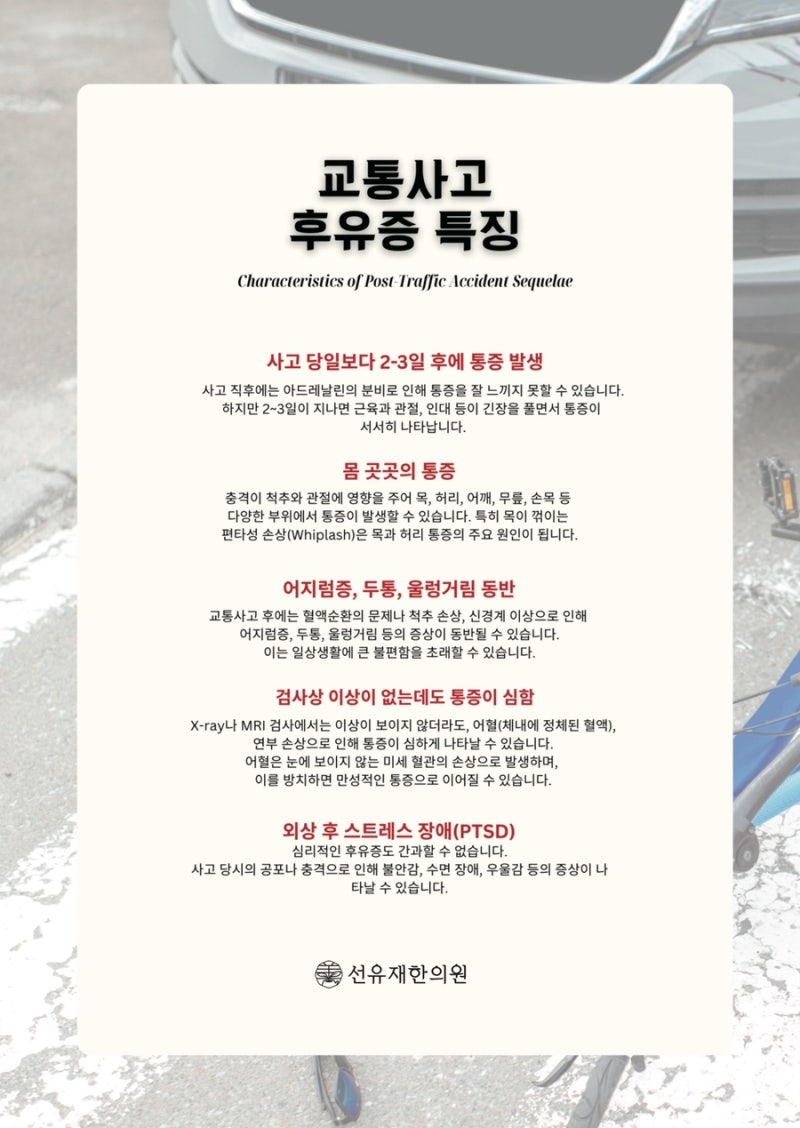
Immediately after an accident, stress hormones like adrenaline can be secreted, temporarily masking pain. However, after 2-3 days, muscle pain, stiffness in the shoulders and lower back, headaches, and fatigue gradually appear. Starting Korean medicine treatment without delay during this period can prevent the progression to chronic pain.
Early on, by alleviating muscle and ligament tension and removing stagnant blood (어혈) to restore the circulation of Qi and blood, the body’s recovery speed increases and the risk of sequelae decreases. “Post-traffic accident sequelae depend not on the severity of the accident, but on the body’s condition and recovery ability. Early treatment determines the speed of recovery and the extent of sequelae.” Characteristics of Post-Traffic Accident Sequelae
– Pain appears 2-3 days after the accident, rather than on the day of the accident. Immediately after an accident, due to the secretion of adrenaline, pain may not be felt clearly. However, after 2-3 days, as muscles, joints, and ligaments relax, pain gradually emerges. – Pain throughout the body: The impact can affect the spine and joints, causing pain in various areas such as the neck, lower back, shoulders, knees, and wrists.
In particular, whiplash, which involves the neck snapping, is a major cause of neck and lower back pain. – Accompanied by dizziness, headaches, and nausea. After a traffic accident, symptoms such as dizziness, headaches, and nausea can accompany due to blood circulation problems, spinal damage, or nervous system abnormalities. These can cause significant discomfort in daily life.
– Severe pain despite no abnormalities on examination. Even if X-ray or MRI scans show no abnormalities, severe pain can occur due to stagnant blood (어혈, blood stasis) and soft tissue damage. Stagnant blood (어혈) results from invisible microvascular damage, and if left untreated, it can lead to chronic pain.
– Post-Traumatic Stress Disorder (PTSD) Psychological sequelae cannot be overlooked. Symptoms such as anxiety, sleep disorders, and depression can arise due to the fear or shock experienced during the accident. It’s easy to dismiss post-traffic accident sequelae, thinking they will naturally improve over time…
However, the longer it is neglected, the more the balance of tense muscles and nerves can break down, allowing pain to become habitual. The body remembers the impact of the accident. A process is needed to release invisible stagnant blood (어혈) and tension, and to restore overall body circulation.
At our Korean medicine clinic, we don’t just focus on the painful area, but manage the patient with an emphasis on the body’s overall balance and recovery ability. We take a step-by-step approach tailored to each individual’s condition, from initial diagnosis and tension relief to circulation improvement and physical recovery. https://m.blog.naver.com/sunyujae21/224071567038
We hope you will join Sunyujae Korean Medicine Clinic, which shares valuable information for a healthy life. Sunyujae Korean Medicine Clinic in Suji-gu pursues evidence-based medicine and integrative medicine.
This post was written directly by the medical staff of Sunyujae Korean Medicine Clinic to provide medical information, in compliance with Article 56(2) and Article 57(3) of the Medical Service Act. The duration and outcome of treatment may vary from person to person, so please consult a qualified practitioner before beginning treatment.
Consultation & Booking
Have questions? Reach us anytime via KakaoTalk or phone.