
If your knees ache when going up or down stairs, the inner part hurts after a long walk, or you feel a sharp pain when standing up from a chair, one thought immediately comes to mind: “Is this the start of arthritis?” Many people visit Sunyujae Korean Medicine Clinic in Dongcheon-dong, Suji-gu, with similar concerns. However, not all knee pain is due to osteoarthritis. Pain that appears after walking longer than usual and pain that begins after twisting the knee can have different causes. The tissues that need to be examined first may also differ between cases where pain occurs only when going down stairs and cases where pain occurs when pressing on the inner part of the knee.
To more accurately determine the cause of knee pain, it’s essential to confirm where the pain is, what movements trigger it, and how your recent activity levels have changed. Today, we will explore the reasons for knee pain and which structures to examine first, depending on the location of the pain.
Reasons for Knee Pain: It’s Not Always Arthritis
The knee is one of the most frequently used joints in our body. It is used countless times a day for actions like walking, running, going up and down stairs, and standing up from a chair. Therefore, it’s not uncommon for people to suddenly report knee pain after a trip, starting hiking, or beginning a new running routine. The knee is not a joint that moves with just one structure. The thigh bone, shin bone, and patella form the joint, and around them, cartilage, meniscus, ligaments, tendons, and muscles work together to bear weight and regulate movement.
If any of these tissues are repeatedly subjected to greater stress than usual, pain can occur. Osteoarthritis is also one of the significant causes of knee pain. Osteoarthritis refers to a condition where changes occur throughout the entire joint, including not only the cartilage but also the bones, synovium, and ligaments. However, knee pain alone does not necessarily mean arthritis. The tissues that need to be checked first can vary depending on which area hurts and under what circumstances the pain began.
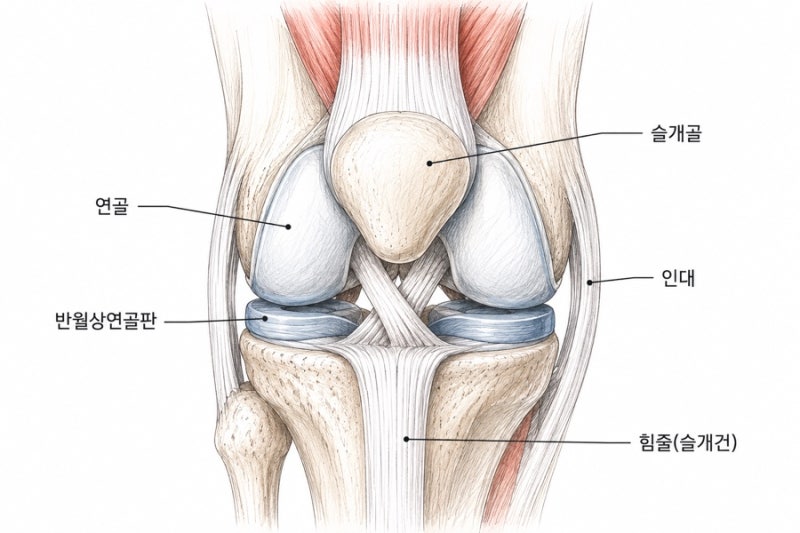
Knee Pain Causes: Why the Location of Pain Matters
Patients all say, “My knee hurts,” but when they point to the actual location, it’s always different. Some point to the front of the knee, others to the inner lower part, and some describe a deep pain between the joints. Different pain locations for the same knee pain indicate that different tissues may be under stress.
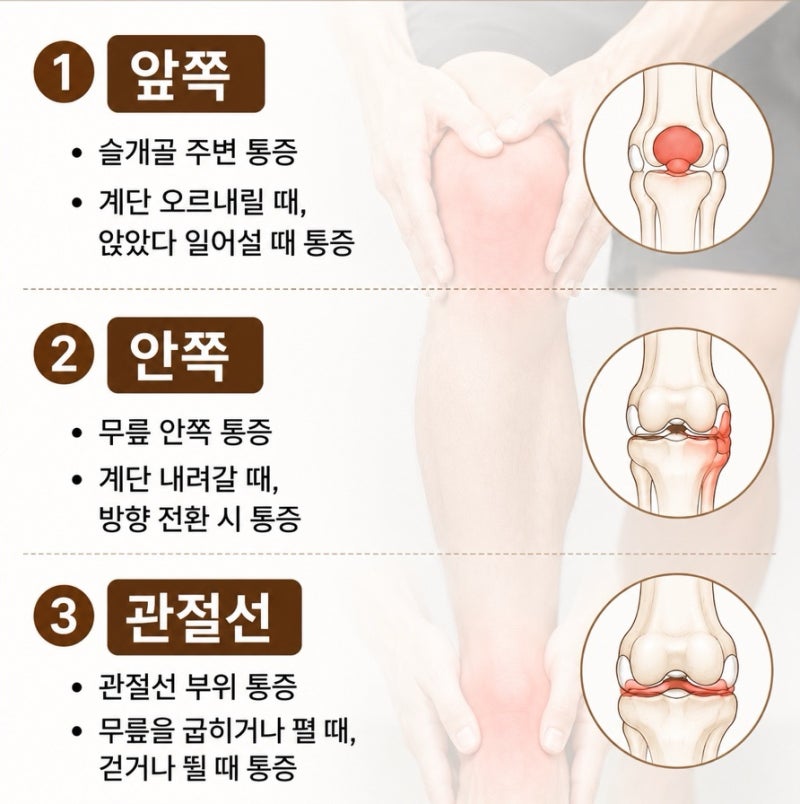
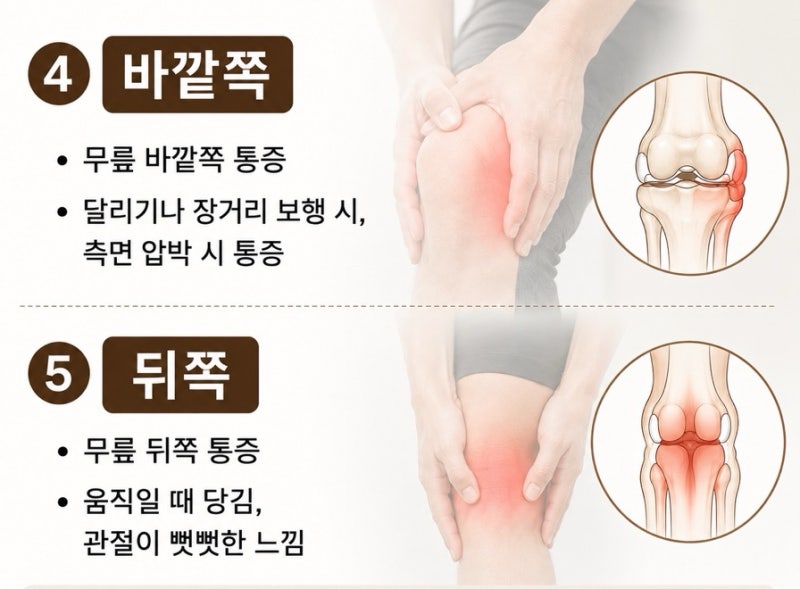
Why the Front of the Knee Hurts When Going Down Stairs
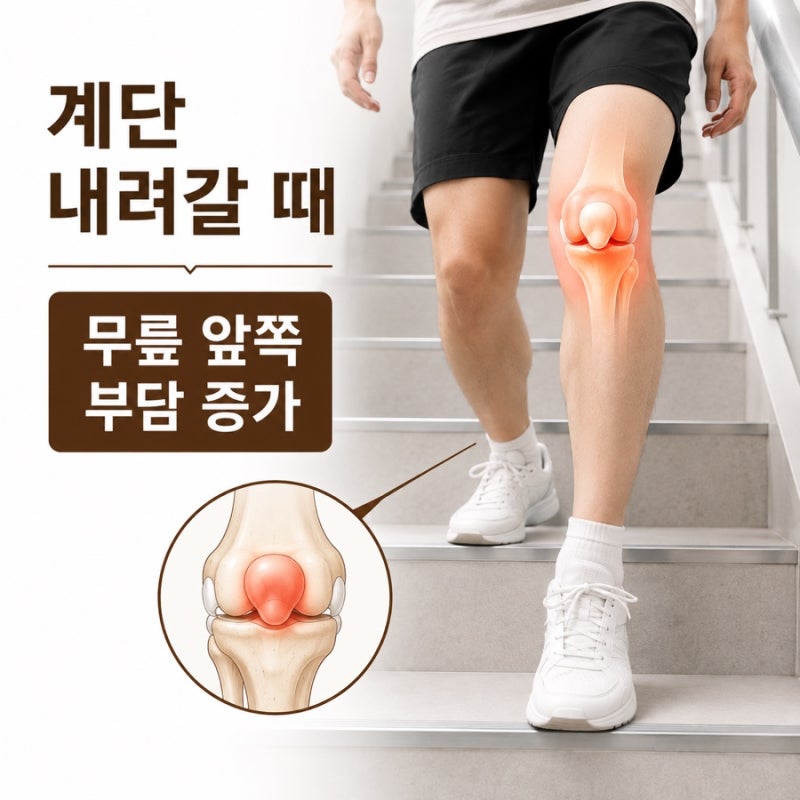
“I’m fine on flat ground, but it only hurts when I go down stairs.” This is a common statement heard in the examination room.
At the front of the knee is the patella, commonly known as the kneecap. The patella moves along the thigh bone as the knee bends and extends. While going up stairs requires force to push the body upwards,
when going down, the muscles at the front of the thigh act like a brake, bearing the body’s weight to prevent it from falling. In this process, the patella and its surrounding areas can become strained as the knee bears weight while bent. This is why people sometimes complain of anterior pain in the following situations:
- When climbing many stairs during a trip
- When suddenly starting hiking or running
- When repeatedly squatting
- When standing up after sitting for a long time
Pain in the knee when going down stairs does not necessarily mean cartilage damage or arthritis. It’s important to consider recent activity levels, the location of the pain, and whether swelling or catching is also present.
Inner Knee Pain: How Is It Different from Arthritis?
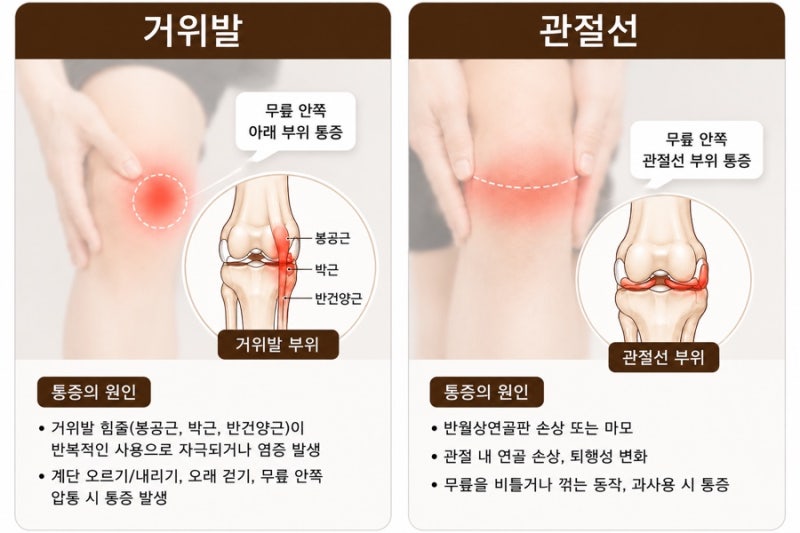
Many people first think of arthritis when they experience inner knee pain. Of course, inner knee pain can commonly occur with osteoarthritis. However, not all inner knee pain originates from the joint itself.
Slightly below the inner joint line of the knee, there is an area where three tendons converge and attach to the shin bone.
This area is called the pes anserinus because its shape resembles a goose’s foot. If the inner lower part hurts after a long walk, or if pressing on the same area reproduces the pain, the tendons around the pes anserinus should also be examined. Conversely, if there is discomfort deep within the joint line, or if swelling and stiffness in the knee are also present, internal joint structures may need to be checked. However, the cause cannot be determined by just a few symptoms, as it’s not uncommon for both the joint and surrounding tendon tissues to be affected simultaneously.
If Your Knee Makes a ‘Clicking’ Sound, Is It a Meniscus Injury?
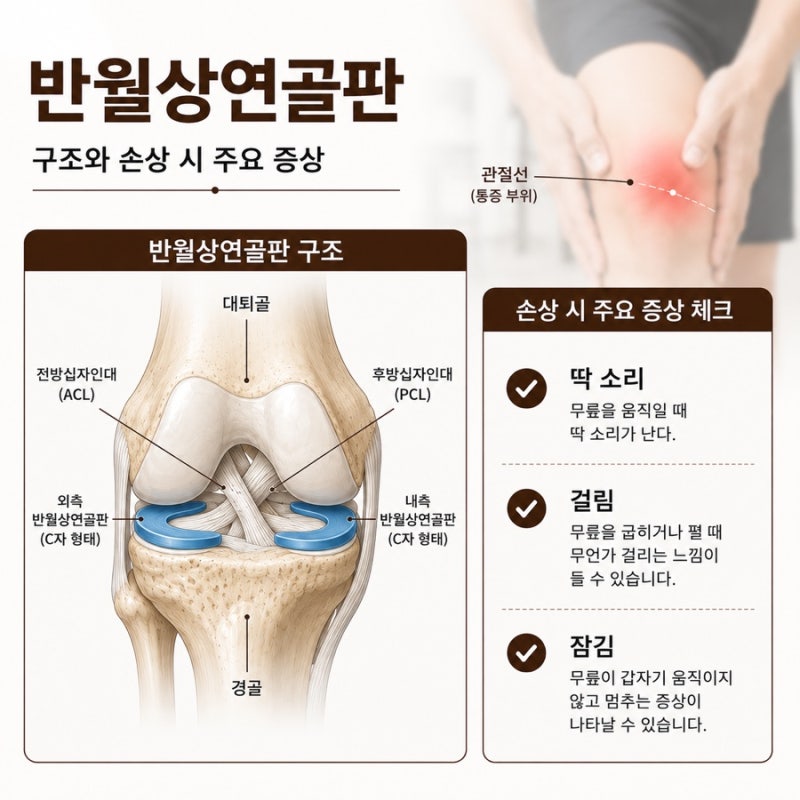
Many people worry that a “click” or “pop” sound when moving the knee might indicate a torn meniscus. However, meniscus damage cannot be determined by sound alone. Sometimes, there is only sound without pain, and it can also be a natural sound produced as the joint moves.
The meniscus is a cartilaginous structure located between the thigh bone and shin bone that distributes shock and helps the joint move stably. If pain began after suddenly changing direction during exercise or twisting the knee, it’s necessary to check the internal joint structures, including the meniscus. If the following symptoms are also present, it’s advisable to have your current condition checked:
- Pain started after twisting the knee.
- The joint line hurts repeatedly.
- There’s a catching sensation when moving.
- The knee cannot fully extend or bend.
- It’s difficult to walk with weight on the knee.
Specifically, a state where the knee feels truly stuck and cannot move is called locking. If you experience locking, sudden swelling, or difficulty walking, it’s best not to delay seeking medical attention.
Don’t Delay Treatment for These Types of Knee Pain!
Knee pain sometimes improves with rest. However, if you have any of the following symptoms, it’s advisable to identify the cause:
- Difficulty walking after a fall or twisting the knee.
- Sudden, significant swelling of the knee.
- The knee is red and hot, accompanied by fever.
- Repeated weakness in the knee.
- The knee catches and cannot fully extend.
- Persistent pain that interferes with daily life.
Especially after trauma, if there is sudden swelling or difficulty bearing weight, medical imaging tests such as X-rays or MRIs may be necessary to check for fractures or internal joint damage.
How Does Sunyujae Korean Medicine Clinic Assess Knee Pain?
At Sunyujae Korean Medicine Clinic in Dongcheon-dong, Suji-gu, treatment is not decided based solely on the symptom of “knee pain.” First, we ascertain when the pain started, how recent activity levels have changed, and what movements cause discomfort. Then, through palpation and movement tests, we examine the location where pain is reproduced and the range of joint motion. Even for the same tendon, pain might occur only when walking, or only when going down stairs. Even for the same inner knee pain, the treatment approach can differ depending on whether the cause is the tendon or the surrounding joint tissues.
When necessary, we utilize musculoskeletal ultrasound. Musculoskeletal ultrasound is an imaging test that allows real-time visualization of the location and condition of muscles, tendons, ligaments, and soft tissues around the joint. It can be helpful in examining soft tissues that are difficult to distinguish by palpation alone, as it allows direct observation of moving tissues. However, ultrasound is not necessary for all knee pain. For deep parts of the meniscus or bone changes that are difficult to confirm with ultrasound alone, we refer to existing X-ray or MRI results or guide patients to medical examinations if needed.
After identifying which tissues are involved in the pain, we determine the appropriate treatment plan, such as acupuncture, pharmacopuncture, or acupotomy, based on the symptoms and tissue condition.
How to Manage Knee Pain in Daily Life
It’s not always best to simply rest when your knee hurts. Conversely, enduring pain and continuing to exercise can also strain the knee. It’s important to adjust your activity level within the range your knee can currently handle.
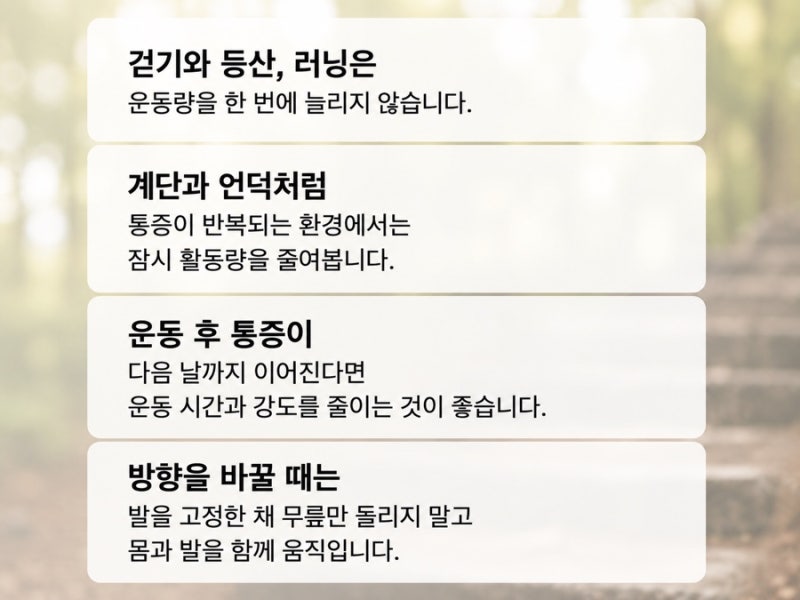
- Do not increase the intensity of walking, hiking, or running all at once.
- Temporarily reduce activity in environments where pain recurs, such as stairs and hills.
- If pain persists into the next day after exercise, it’s advisable to reduce the duration and intensity of your workout.
- When changing direction, move your body and feet together instead of just rotating your knee while keeping your feet fixed.
Even small changes in habits can help reduce the burden on your knees.
Frequently Asked Questions (FAQ)
Q. Is all knee pain arthritis?
No. Pain can originate from various structures, including tendons, ligaments, meniscus, and tissues around the patella.
Q. Is there a reason why it only hurts when going down stairs?
When going down stairs, the thigh muscles slowly bear the body’s weight, which can increase the strain on the front of the knee.
Q. If my knee makes a sound, does it require treatment?
Sound alone does not necessarily require treatment. If pain, swelling, catching or locking, and limited movement are also present, it’s advisable to have your current condition checked.
Q. Is an ultrasound examination always necessary for knee pain?
It is not necessary in all cases. It is selectively used when further examination of soft tissues like tendons and ligaments is needed, based on the results of the medical interview, palpation, and movement tests.
Sunyujae Korean Medicine Clinic in Suji-gu pursues evidence-based and integrative medicine.
This post was written directly by the medical staff of Sunyujae Korean Medicine Clinic to provide medical information, in compliance with Article 56(2) and Article 57(3) of the Medical Service Act. The duration and outcome of treatment may vary from person to person, so please consult a qualified practitioner before beginning treatment.
Consultation & Booking
Have questions? Reach us anytime via KakaoTalk or phone.