Doctor, the surgery went well, but why do my legs still feel tight and numb?
“Doctor, the surgery went well, but why do my legs still feel tight and numb?” I receive questions like this more often than you’d think in the clinic.
If the surgical site has healed completely but the same area continues to be uncomfortable, scar tissue around the nerve could be one of the causes.
This is called nerve adhesion.
I am Dr. Hyocheong Chae, director of Sunyujae Korean Medicine Clinic in Dongcheon-dong, Suji-gu.
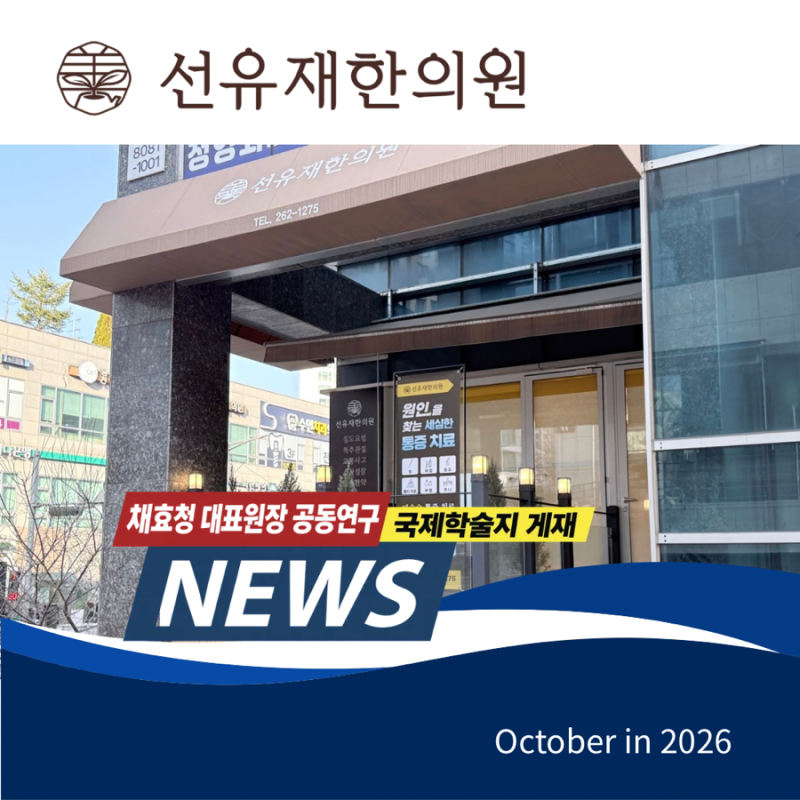
This time, I published a paper in an international journal based on research that addresses this very topic of nerve adhesion and acupotomy treatment. I will share the research news from the October issue of Monthly Sunyujae along with an interview from the Korean Medicine Newspaper , and explain what nerve adhesion is in simple terms.
Acupotomy Research Published in an International Journal
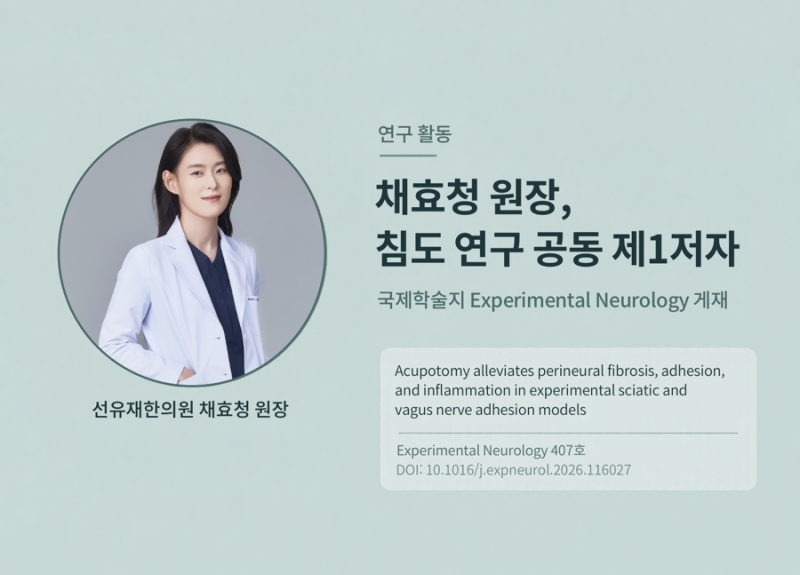
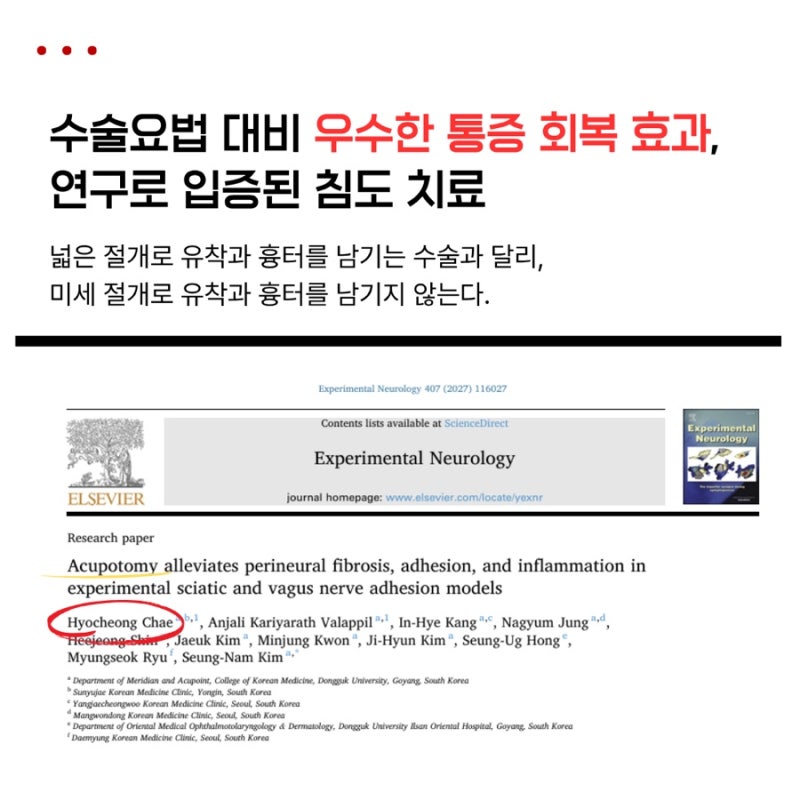
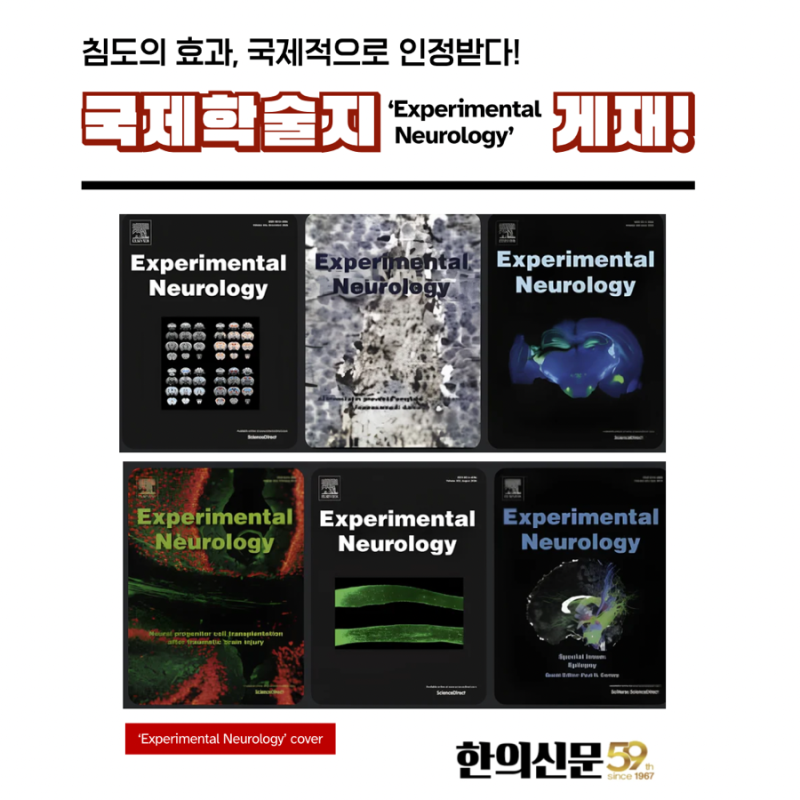
Acupotomy research conducted with Professor Seung-Nam Kim’s research team from Dongguk University College of Korean Medicine has been published in the international neuroscience journal ‘Experimental Neurology’.
I participated as a co-first author, and Professor Seung-Nam Kim participated as the corresponding author. A co-first author position is given to researchers who have contributed most significantly to the paper. This news was published as an article in the Korean Medicine Newspaper on October 12, 2026, and I also had an interview with Professor Seung-Nam Kim. The October issue of Monthly Sunyujae featured the article and interview in their entirety, and I have included excerpts from the interview and memorable passages below this post. This paper is particularly meaningful to me as it is the result of connecting the pain I’ve encountered in the clinic, while serving as the Planning Director for the Korean Acupotomy Medical Society, to research.
What Is Nerve Adhesion, in Simple Terms?
Nerves move by sliding slightly between surrounding tissues every time the body moves. Even when you bend your head or stretch your leg, nerves slightly lengthen and move along. However, the story changes when scar tissue forms as a result of surgery, injury, or chronic inflammation healing. If scar tissue holds the nerve to the surrounding tissue, the nerve cannot slide when you move and gets pulled. It’s similar to a power cord taped to a wall becoming taut with just a slight pull. This condition is called nerve adhesion, and it can manifest as tightness, numbness, or pain. Sciatica, which causes leg numbness and tightness, or carpal tunnel syndrome, which causes hand numbness, can also be related to adhesion.
This is the part I really want to convey. Even if a surgery is successful, scars formed during the healing process can become a new source of discomfort. The question “I had surgery, so why am I still in pain?” is sometimes answered here. I hear such stories more frequently in the clinic, especially after surgeries involving areas close to nerves, such as lumbar or cervical disc surgery, wrist surgery, or fracture and ligament surgeries.
What Did This Study Investigate?
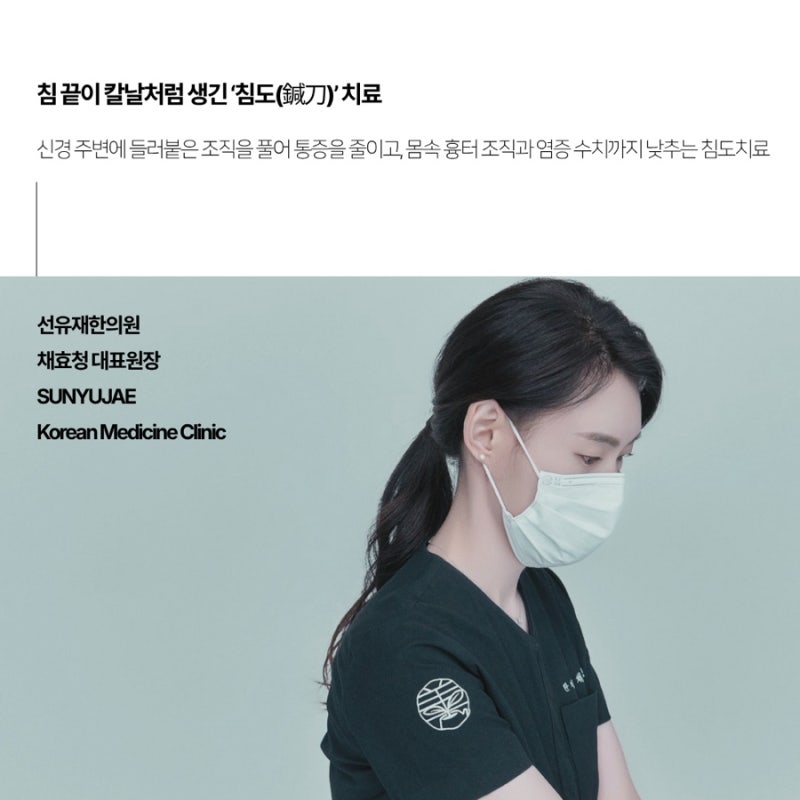
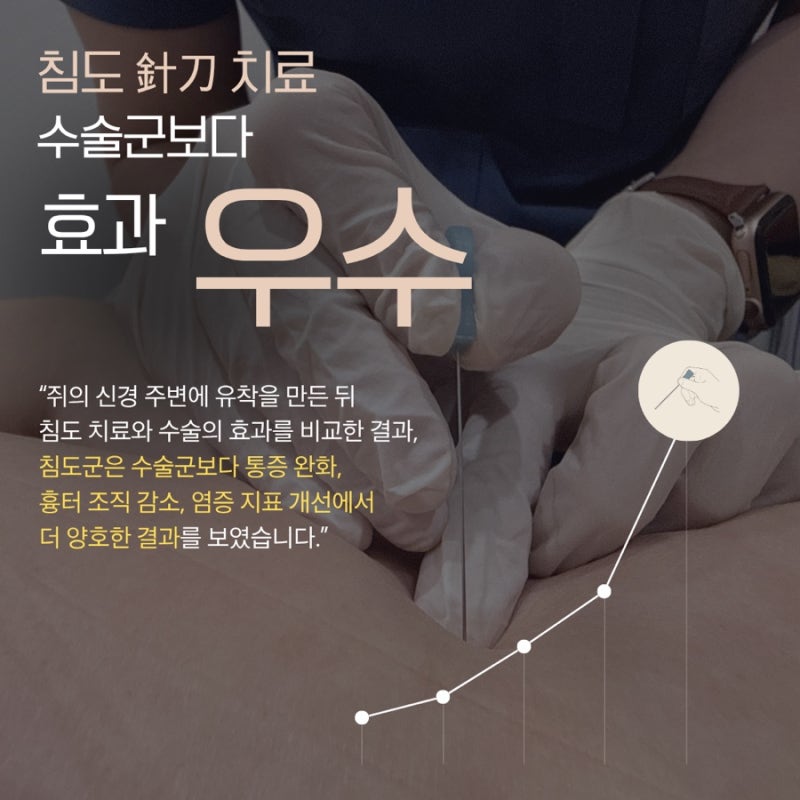
Acupotomy, as its name suggests, is a therapeutic tool combining a needle (鍼, chim) and a knife (刀, do). Its tip is a flat blade, 0.35mm wide, allowing it to be inserted like an acupuncture needle without skin incision. It then precisely cuts and separates only the adhered areas within the tissue.
After the procedure, only a needle mark remains, classifying it as a ‘minimally invasive treatment’. Our research team created adhesions around the sciatic nerve and vagus nerve in rats. We then divided them into groups: one receiving acupotomy treatment, one receiving re-surgery, and one receiving no treatment, comparing them with normal rats. The sciatic nerve is a thick nerve that runs from the buttocks down to the legs. The vagus nerve is a nerve that passes through the neck and extends to organs in the chest and abdomen.
The animal model with vagus nerve adhesion was newly devised by our research team for this study.

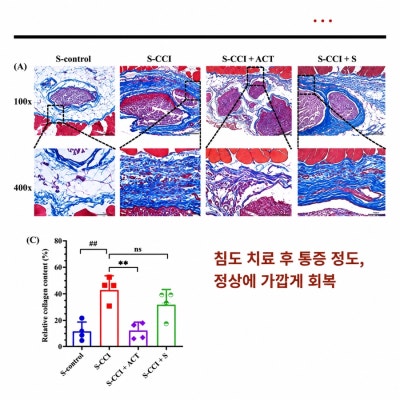
Looking at the results, the pain sensitivity score in response to paw stimulation was 0.30 for the untreated group and 0.87 for the acupotomy-treated group.
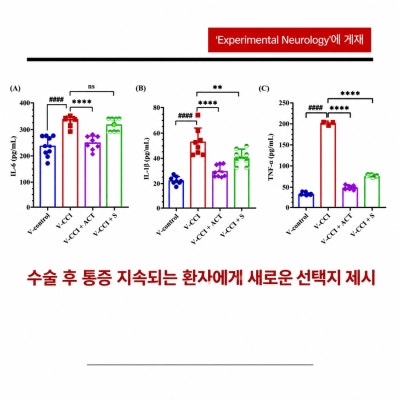
A higher score indicates less pain response to typical stimuli. Collagen, which forms scar tissue around the nerve, also decreased to a level similar to normal rats in the acupotomy-treated group. There was one more notable result regarding the vagus nerve. When adhesions formed around the vagus nerve, inflammatory substances (IL-6, IL-1β, TNF-α) in the blood all significantly increased. This means that adhesion in one area can affect systemic inflammation. After acupotomy treatment, all three values decreased, and IL-6 and IL-1β returned to levels similar to normal rats. I often explain these results in two ways.
One is the ‘physical’ change, where the blade-shaped tip of the acupotomy needle delicately separates hardened scar tissue, releasing the pressure on the nerve.
The other is the ‘biological’ change, where scar tissue and inflammation decrease after the procedure, and even inflammatory markers in the blood go down. We also noted that tissue damage caused by re-incision could lead to further inflammation and scarring. This is why we considered a minimally invasive approach, which disturbs surrounding tissues less, to be significant in adhesion research.
What We Discussed in the Korean Medicine Newspaper Interview
An interview with Professor Seung-Nam Kim and me was published in the Korean Medicine Newspaper on October 12. The interview, as featured in the October issue of Monthly Sunyujae, is reproduced here.
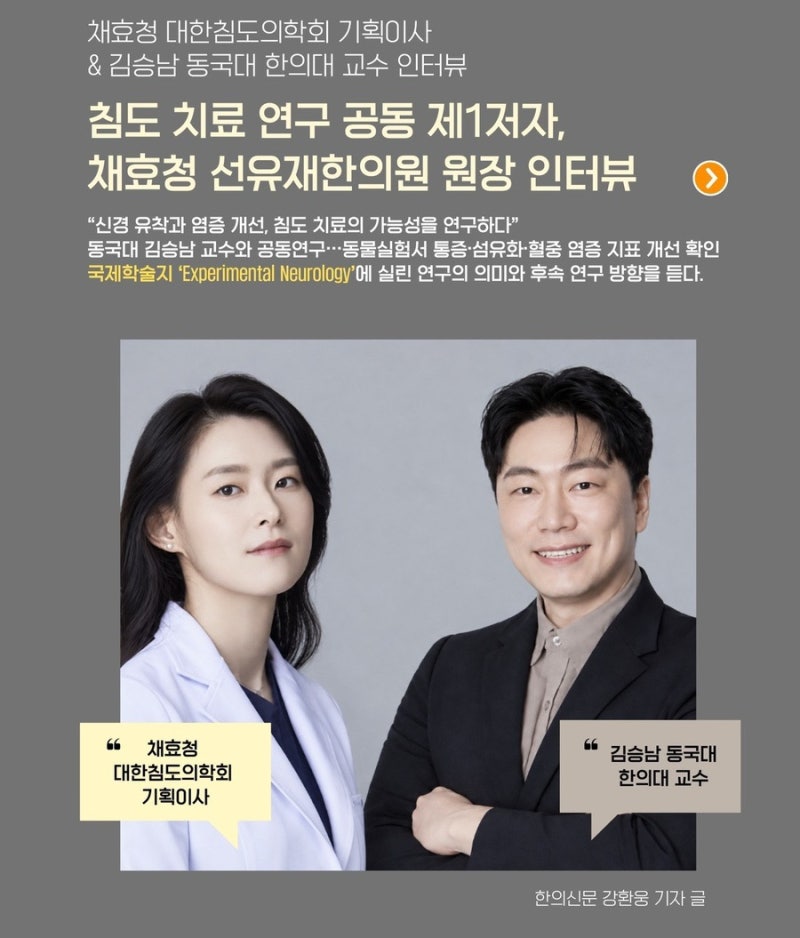
Recently, animal experiment results showing that acupotomy treatment reduces pain by releasing nerve adhesions, and also decreases scar tissue around nerves and inflammatory substances in the blood, were published in the international neuroscience journal ‘Experimental Neurology’. This study is particularly noteworthy because it elucidated the mechanism of acupotomy treatment in two nerve adhesion models (sciatic nerve and vagus nerve) and directly compared its efficacy with conventional surgical adhesiolysis (re-surgery).
Let’s hear about the significance and behind-the-scenes stories of the research from Dr. Hyocheong Chae, co-first author and Planning Director of the Korean Acupotomy Medical Society.
Q. What is ‘Experimental Neurology’, where the paper was published? “Experimental Neurology (IF=4.8) is a leading international SCI(E) journal in the field of neuroscience, founded in 1959 and continuously published for over 60 years by Elsevier, the world’s largest academic publisher. It primarily covers research that experimentally elucidates why and how neurological diseases occur, making it one of the most closely watched journals by researchers and clinicians studying nerve damage and neuropathic pain. Furthermore, the fact that acupotomy research from Korean medicine was published in a traditional neuroscience journal, known for not easily granting publication approval, suggests that the efficacy of acupotomy treatment has been recognized by neuroscience standards.”
Q. What did this paper elucidate? “This study elucidated the mechanism by which acupotomy treatment is effective in nerve entrapment disorders. When nerves are compressed or adhered to scar tissue, pain and numbness occur. In clinical practice, we have experienced symptom improvement by releasing adhesions with acupotomy, but research scientifically elucidating its mechanism has been rare. In this animal experiment, we confirmed both the ‘physical’ effect of acupotomy, which delicately incises and dissects scar tissue around the nerve, and the ‘biological’ effect of reducing scar tissue and blood inflammatory markers. This demonstrates the potential to improve the pathological environment around nerves, beyond simple adhesiolysis.”
Q. Were there any difficulties during the research process? “As is often the case with all research, financial limitations were a challenge. If more funding had been secured, we could have sufficiently increased the number of experimental animals and conducted nerve conduction studies or molecular-level analyses, which remains a regrettable aspect. Another difficulty was securing research personnel. To design and conduct animal experiments like this one over several months, a dedicated researcher is needed. However, in reality, there are still not many researchers in universities or research institutions who are committed to Korean medicine research.
Especially for the vagus nerve model, we had to build it from scratch ourselves, and with too few hands, it took a great deal of trial and error and time.”
Q. Any memorable episodes during the paper submission process? “Honestly, I wasn’t confident that a neuroscience journal would allow the term ‘Acupotomy’ to be included directly in the title. I considered using other indirect expressions, but being able to use the name ‘acupotomy’ as intended by the research team is a good achievement in itself. During the review process, there was a question about the mortality rate of the experimental rats. While the vagus nerve area is commonly treated by Korean medicine doctors in clinical practice, external reviewers asked us to address concerns that treating the vagus nerve could carry a high risk of serious adverse events such as death.
In response, we stated that there were no deaths or side effects due to the procedure in this experiment, and the publication process proceeded smoothly thereafter. While researchers and Korean medicine doctors utilizing acupotomy treatment in clinical practice constantly confirm its safety and effectiveness in their clinics, this incident served as a reminder that safety must be continuously reported with data, even before treatment efficacy.”
Q. How do you plan to develop this research further? “First, we aim to elucidate the molecular mechanisms by which acupotomy reduces scarring and inflammation in more detail, and to confirm whether nerve function actually recovers through nerve conduction studies. For the vagus nerve, the next task is to more directly demonstrate the process by which adhesion impairs nerve function and leads to systemic inflammation. We also plan to observe for a long time how long the treatment effect lasts and whether adhesions recur. Ultimately, we must move towards clinical trials involving patients. As stated in the paper, these results are achieved when a skilled practitioner performs the procedure based on accurate anatomical knowledge, so we must establish both procedural training and a safety reporting system concurrently.
Furthermore, I want to actively pursue collaborative research with researchers from other fields to broaden the scope of acupotomy research.”
Q. Any other comments? “It was meaningful to be able to objectively and scientifically prove the efficacy of acupotomy, which I have observed daily in patients in the clinic. I hope this achievement serves as an opportunity for more Korean medicine doctors to connect their clinical experience with research, and I will continue to broadly and meticulously demonstrate the efficacy and safety of acupotomy in the future.”
Points to Note When Reading This Study
This study is an animal experiment. We cannot immediately state that the exact same results will be observed in humans. Our research team is clear about this, and therefore, we are discussing clinical trials involving patients as the next step. Furthermore, these results were achieved when a skilled practitioner performed the procedure based on accurate anatomical knowledge. This means that for acupotomy, who performs it, where, and with what level of precision, are crucial for effective treatment.
Could My Discomfort Be Related to Adhesion?
See if any of the items in the table below apply to you.
| If you feel this | What to note down |
|---|---|
| The surgical site has healed, but the same area keeps pulling | The date of surgery and when the discomfort started again |
| Numbness gets worse only in certain postures | Which posture, and after about how many minutes |
| The area around the scar feels firm and doesn’t glide when touched | Where the firm spot is |
| Stretching makes it tingle more instead of less | Which direction of stretching triggers it |
Noting down these details for about a week before your appointment can help narrow down the cause. If you suddenly lose strength in your legs, or if bowel and bladder control is unusual, it’s a different matter. In such cases, you should seek immediate medical attention without delay.
This paper is a study that experimentally investigated how acupotomy works on adhesions.
If you are struggling with persistent tightness or numbness after surgery, I recommend checking the current condition of the nerves around the affected area. I will continue to translate what I’ve observed in the clinic into research and share the news through monthly magazines and this blog.
[ Sources ]
Korean Medicine Newspaper, “Acupotomy Treatment Confirmed to Relieve Pain and Inflammation by Releasing Nerve Adhesion” (https://www.akomnews.com/68641) (2026.10.12)
Korean Medicine Newspaper interview with Hyocheong Chae and Seung-Nam Kim (Reporter Hwan-woong Kang)
Monthly Sunyujae, October 2026 issue
Experimental Neurology Vol. 407 (DOI: 10.1016/j.expneurol.2026.116027)
Sunyujae Korean Medicine Clinic in Suji-gu pursues evidence-based medicine and integrative medicine.
This post was written directly by the medical staff of Sunyujae Korean Medicine Clinic to provide medical information, in compliance with Article 56(2) and Article 57(3) of the Medical Service Act. The duration and outcome of treatment may vary from person to person, so please consult a qualified practitioner before beginning treatment.
Consultation & Booking
Have questions? Reach us anytime via KakaoTalk or phone.